- Phone / WhatsApp:+86 157 0677 9792
- sales@toonice.com
-
English



North American versus European Distribution Systems
Jul 31,2026
A distribution system is the power infrastructure that steps down high-voltage electricity from the transmission grid and delivers it to end users. It helps ensure residential and commercial facilities receive safe, reliable voltage, consisting of physical components such as conductors, transformers, and protective switchgear.
North America and Europe approach distribution system design from distinct philosophies. North America favors a decentralized architecture with long medium-voltage lines and many small transformers for few users, whereas Europe prefers a centralized model featuring large-capacity transformers and short low-voltage lines.
This article outlines the similarities and differences between North American and European distribution systems across network topology, transformer configuration, operating voltage, cost, and reliability.
What Are the Similarities?
Fundamental Hardware Infrastructure
North American and European distribution systems share a remarkably similar physical foundation, relying on standardized electrical equipment to maintain operations. Regardless of location, the core elements of a distribution grid include copper or aluminum conductors for energy transport, distribution transformers for voltage adjustment, high-voltage insulators for electrical isolation, and circuit breakers or fuses for protection. These basic hardware components function on identical physical principles, serving to step down voltage and deliver electricity safely from substations to consumers.
Radial Distribution Topology
Terminal distribution networks in both regions rely on radial distribution as their primary structural design. A radial network extends outward from a central substation along multiple branch feeders, which simplifies flow calculations and protection device schemes. Utilizing a radial layout effectively reduces early construction overhead and maintenance complexity. While European utilities occasionally integrate loop structures in dense urban zones, both regions retain this outward-radiating pattern for most medium- and low-voltage end runs.
Where Do the Differences Lie?
Transformer Configuration Patterns
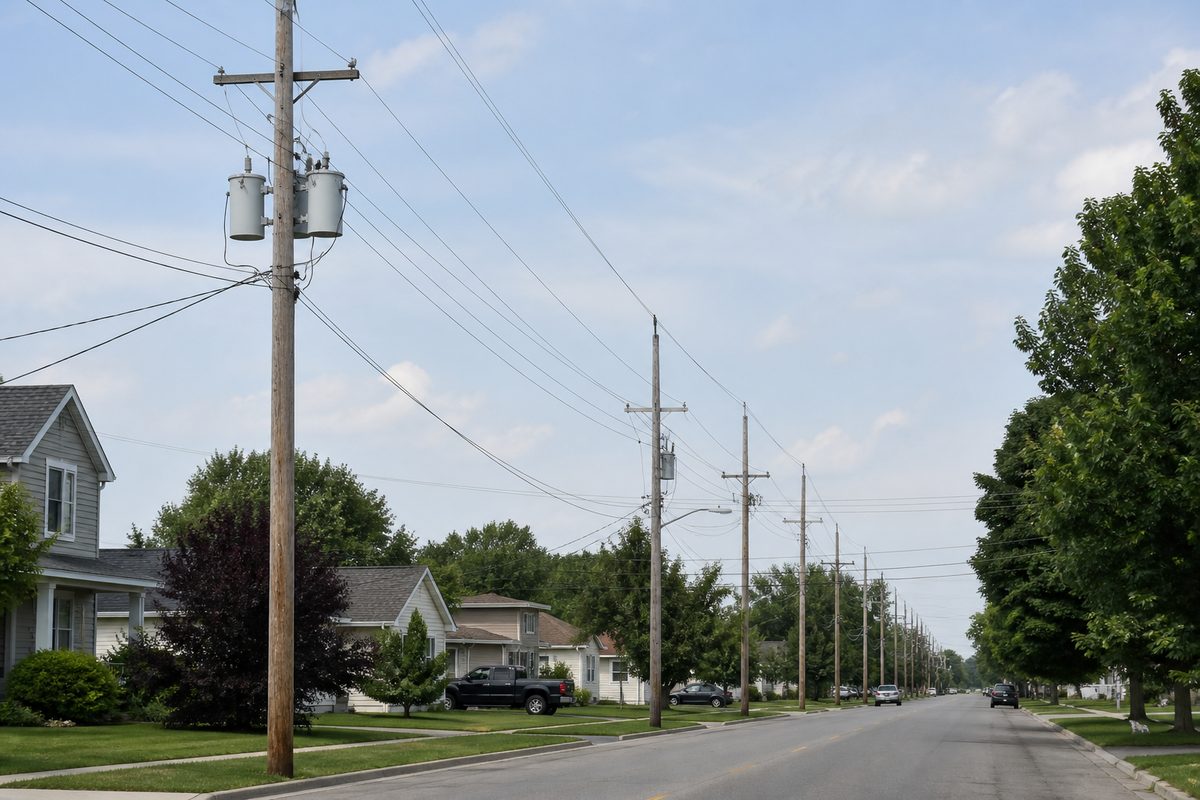
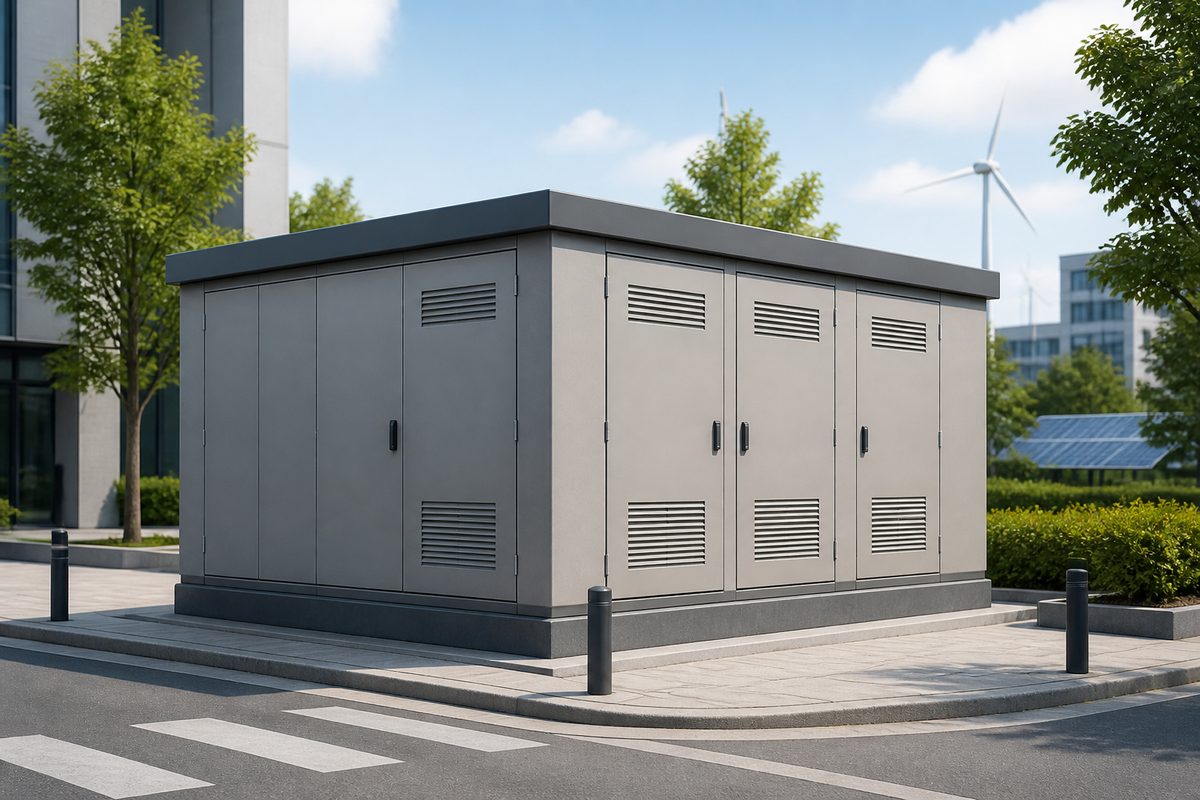
Transformer density and capacity represent one of the primary distinctions between North American and European power systems. The North American model brings high voltage close to the load center, deploying numerous small single-phase transformers ranging from 10 to 50 kVA that serve one to eight homes each. In contrast, European systems adopt a centralized distribution approach by installing larger three-phase transformers ranging from 100 to 1000 kVA, allowing a single unit to power dozens or hundreds of households and dictating the length of downstream low-voltage runs.
Secondary Low-Voltage Supply
The voltage level delivered to consumers directly shapes network efficiency and equipment design. North America employs a 120V/240V split-phase system where standard appliances run on 120V while heavy equipment uses 240V, a design that keeps low-voltage line losses restricted to a tiny physical footprint. Europe uses a 230V/400V three-phase four-wire system where homes receive either 230V single-phase or 400V three-phase power, using higher voltage to reduce current for equivalent power loads and enable longer low-voltage cable runs.
Capital Expenditure and Maintenance Costs
System design choices drive clear variations in upfront capital costs and long-term operating expenses. Because North America requires an extensive number of individual transformers, initial equipment procurement and installation costs run high, though low-voltage conductor usage remains minimal. European grids install fewer total transformers, yet they must lay extensive low-voltage cables with larger cross-sectional areas and higher insulation ratings, raising cable network costs. Consequently, North American layouts prove more cost-effective in sparsely populated regions, whereas European designs yield operational scale benefits in dense residential districts.
North America Snapshot
Europe Snapshot
Personal and Electrical Safety
Voltage levels and protection mechanisms shift the primary safety risks between the two regions. North American indoor power operates at 120V, where lower voltage to ground reduces fatal shock risks during accidental contact, though higher current demands from heavy appliances elevate heat generation and fire risks within wiring. European interiors operate at 230V, where higher voltage increases shock severity, prompting European utilities to mandate sensitive Residual Current Devices and strict grounding standards that mitigate high-voltage risks.
System Reliability and Outage Footprints
Outage scope serves as a standard metric for comparing grid reliability during equipment failure. In North American networks, single transformers power very few consumers, meaning a transformer failure or lightning strike affects only a handful of households and contains the disruption. In European centralized networks, a fault on a single three-phase transformer or low-voltage trunk line cuts power to entire blocks or hundreds of residents. However, European networks incorporate low-voltage tie switches and loops that help restore power through alternate routes following a fault.
Power Quality and Phase Balance
Maintaining phase balance across three-phase supply lines is a requirement for grid stability and power quality. North American networks connect numerous single-phase transformers along medium-voltage feeders, which can introduce severe load imbalances across phases and cause voltage fluctuations or secondary losses. European networks maintain three-phase distribution from the substation down through the transformer, allowing loads to balance naturally on the secondary side, delivering higher power quality, minimizing harmonic distortion, and providing direct three-phase power to homes and light commercial facilities.
Visual Aesthetics and Cable Routing
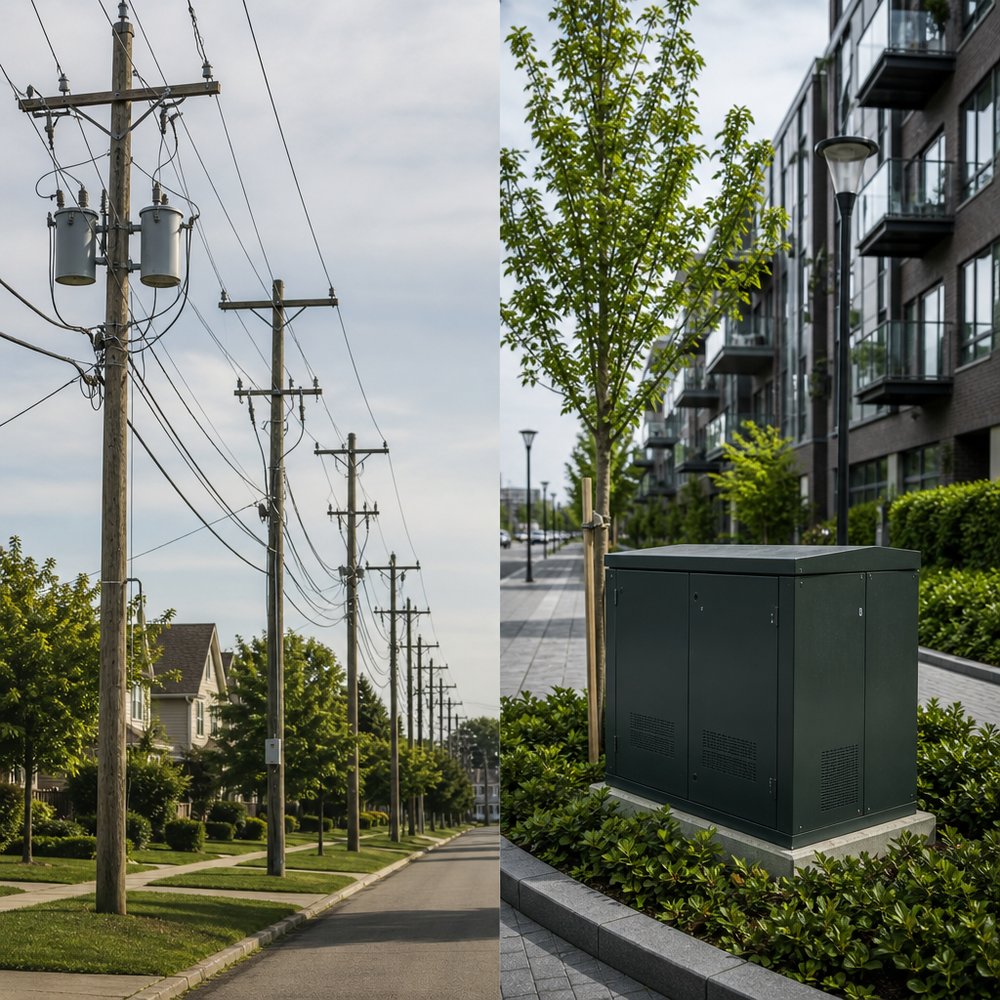
Distribution routing heavily influences urban visual appeal and local infrastructure planning. North America historically favored overhead lines, creating recognizable streetscapes with wooden utility poles and pole-mounted bucket transformers. Although newer developments place cables underground, retrofitting older districts remains difficult. High population density and historical preservation led European utilities to adopt underground cabling early, hiding distribution transformers inside enclosures or compact substations to preserve town skylines and visual appeal.
Related Toonice Product Categories
Matching equipment to regional distribution practice often starts with the right transformer and substation package.
Conclusion
Neither North American nor European distribution systems are inherently superior, as both evolved in response to distinct geography, population density, and industrial history. North America excels in high-voltage reach, granular fault isolation, and lower indoor shock risks, while Europe offers higher power quality, efficient high-density energy transport, and clean urban integration. Understanding these technical differences provides context for power engineers and equipment manufacturers working across international markets.
Planning equipment for North American or European-style networks? Get guidance from Toonice.
FAQs
Why does North America use 120V for household power while Europe uses 230V?
North America kept Edison’s lower voltage standard for safety. Europe chose 230V to cut line losses and support higher power loads.
How do grid frequencies differ between North America and Europe?
North America operates at 60 Hz, while Europe operates at 50 Hz.
Which distribution design produces lower electrical line losses?
European networks produce lower line losses because higher voltage reduces current and maintains better phase balance.
Why are utility poles and cylindrical transformers common in North America?
North America uses many small pole-mounted transformers because overhead wiring was cheaper and faster to build across wide suburban areas.
Can European residential homes access three-phase power directly?
Yes, European grids deliver three-phase power into residential streets, letting homes connect directly to 400V for heavy electrical loads.

--- END ---

MV & LV Equipment Manufacturer · Wenzhou, China
COMPANY
PRODUCTS
INDUSTRIES