- Phone / WhatsApp:+86 157 0677 9792
- sales@toonice.com
-
English



What You Need to Know About Ring Main Units?
May 10,2026
A Ring Main Unit (RMU) is a key building block in modern medium-voltage distribution networks, enabling reliable power supply, fast fault isolation, and flexible network operation.
Designed for compact installation and high operational safety, RMUs are widely used across urban infrastructure, industrial facilities, and critical power systems.
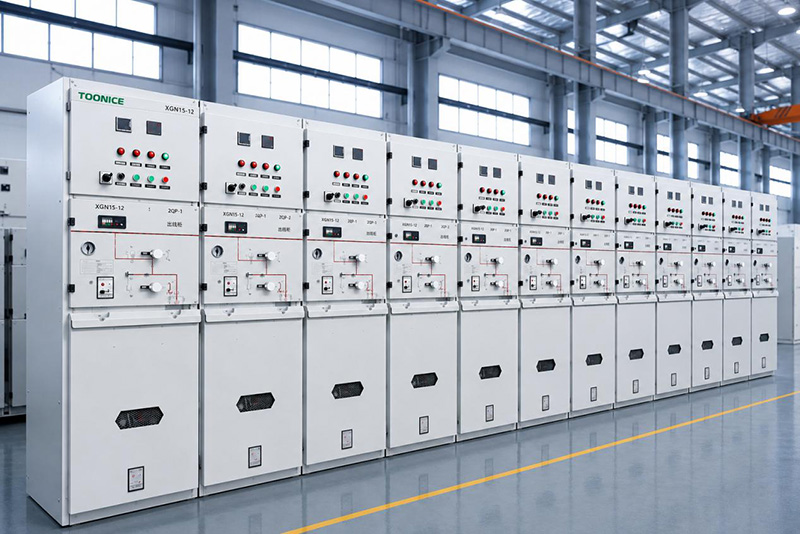
What is a Ring Main Unit (RMU)?
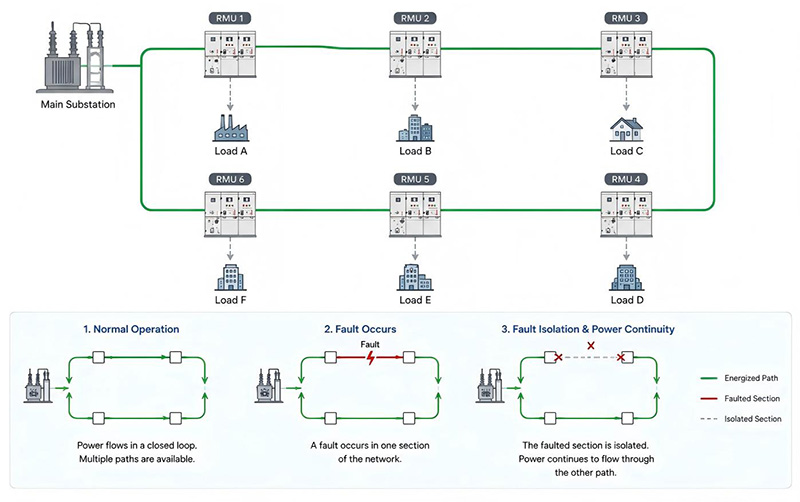
Power can flow through more than one path. When a fault occurs in one section, the affected part is isolated while the rest of the network continues to operate.
A Ring Main Unit is a compact, metal-enclosed medium-voltage switchgear used in power distribution networks. It connects incoming and outgoing feeders and provides switching, protection, and isolation functions within the network.
Its key feature is its role in ring distribution systems. Power can be supplied through more than one path, forming a looped network structure.
When a fault occurs in one section, the affected part can be isolated while electricity continues to flow through another path. This helps maintain supply continuity and reduces the impact on end users.
Compared with traditional radial systems, RMU-based ring networks allow operators to manage power flow more flexibly and respond to faults with greater speed and control.
Position of RMU in a Power Distribution System

In a ring distribution system, RMUs are installed between substations and transformers to form a closed-loop network. This configuration enables flexible power routing and allows faulty sections to be isolated without interrupting the overall supply.
Core Components of RMU
The internal structure of an RMU is organized to ensure stable switching, protection, and power distribution within medium voltage networks. Each component works together to maintain continuous operation, support safe handling during faults, and provide reliable performance across different environments.
An RMU integrates several core components to ensure safe switching, reliable protection, and efficient power distribution:
| Component | Role |
| Load Break Switch | Manages switching under normal conditions; supports network reconfiguration during maintenance or faults |
| Fuse or Circuit Breaker | Interrupts fault currents during overload or short circuit events, protecting cables, transformers, and downstream equipment |
| Busbar System | Links multiple circuits within the unit, enabling smooth distribution between incoming and outgoing feeders |
| Earthing System | Provides grounding during maintenance or fault conditions; ensures safe discharge of residual currents before manual operation |
| Insulation & Sealing System | Gas-insulated or solid-insulated designs protect internal components from dust, moisture, and external impact |
Key Advantage of RMU in Power Distribution
RMU supports stable and flexible power distribution in modern networks. Its configuration allows operators to maintain service continuity, respond quickly to faults, and manage growing demand with greater control.

Together, these features position RMU as a reliable and space-efficient solution for modern distribution networks, where operational continuity and safety are critical.
Typical Applications of RMU

RMU is widely deployed across different sectors where stable power supply and flexible distribution are required. Its compact structure and ring network configuration allow it to adapt to both dense urban environments and large scale industrial systems, supporting consistent performance under varying load conditions.
- Urban distribution networks: Load balancing and fast switching in densely populated residential and commercial areas.
- Industrial and commercial projects: Manufacturing plants, shopping centers, and office complexes requiring uninterrupted power for sensitive systems.
- Renewable energy systems: Wind farms and solar plants connecting generation sources to the grid, managing distributed power flows and bidirectional supply.
- Critical infrastructure: Hospitals, transport hubs, and data centers where even brief interruptions can have serious operational consequences.
How to Select the Right RMU
Selecting an appropriate RMU requires a clear understanding of project conditions, operational expectations, and future development plans. A well matched solution can improve system stability, reduce operational risks, and support long term network growth.
To simplify the decision process, the following flowchart outlines the key steps for selecting the most suitable RMU configuration.

At TOONICE, we support clients through each step of this selection process, providing tailored RMU configurations based on project-specific requirements.
Our RMU Solutions

TOONICE provides GIS Ring Main Units designed for medium-voltage distribution systems from 10 kV to 36 kV, combining compact design, reliable performance, and strong environmental adaptability.
Our solutions are widely applied in urban networks, underground substations, industrial facilities, and coastal environments where space constraints and operating conditions demand high reliability.
Each unit is fully assembled and tested prior to delivery, ensuring faster on-site installation and consistent long-term performance.
For projects with different space or budget considerations, we also offer Air-Insulated (AIS) switchgear solutions, allowing flexible configuration based on technical and economic requirements.
One recent example is our Saudi Arabia RMU project, where we delivered 400 units for a large-scale distribution network under demanding conditions.
→ Read the Saudi Arabia RMU Project Case Study
Conclusion
With continuous advancements in automation and digital monitoring, RMU solutions are evolving to provide greater control, efficiency, and system visibility.
At TOONICE, we are committed to delivering reliable and high-performance RMU solutions tailored to modern power distribution needs.
If you are planning a project or need technical guidance, our engineering team is ready to support you.
Not sure which RMU is right for your project?
Our engineering team can review your site conditions and recommend the most suitable solution — at no obligation.
View GIS RMU Product Details →
FAQ
What is the difference between RMU and traditional switchgear?
RMU uses a ring network configuration, while traditional switchgear often follows a single direction supply path. RMU offers improved continuity and faster recovery during faults, along with greater flexibility in network operation.
Does RMU always use SF6 gas?
No. Alternatives such as solid insulation or environmentally friendly gases are available. Selection depends on project requirements, environmental considerations, and regulatory standards.
What voltage levels can RMU handle?
It typically operates within medium voltage ranges, commonly from 10kV to 36kV. Specific configurations may vary depending on regional standards and application needs.
Can RMU support smart upgrades?
Yes. Many modern RMU systems include monitoring devices and communication interfaces that support remote operation, real time data collection, and system diagnostics.
How often does RMU need maintenance?
Maintenance demand remains relatively low due to sealed construction and reliable components. Periodic inspection helps ensure consistent performance and early detection of potential issues.

--- END ---

MV & LV Equipment Manufacturer · Wenzhou, China
COMPANY
PRODUCTS
INDUSTRIES