- Phone / WhatsApp:+86 157 0677 9792
- sales@toonice.com
-
English


Do Substations Emit Electromagnetic Radiation?
May 13,2026
Substations are facilities in power systems that are used for voltage conversion and power distribution, and they support urban electricity supply, industrial operations, and daily residential power usage.
During operation, substations do generate power frequency electromagnetic fields, although their intensity is usually controlled under strict national standards, which means that they normally do not cause noticeable harm to human health.
This article explains whether substations produce harmful electromagnetic fields and how people should view this issue scientifically.
What Is a Power Substation?
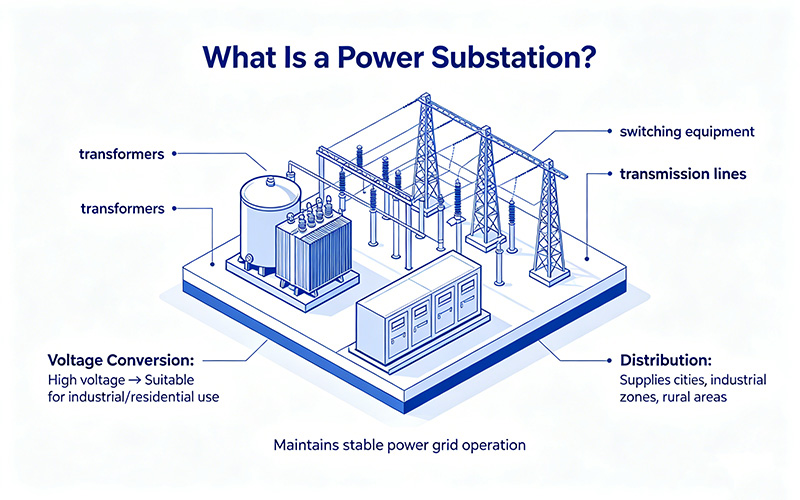
A power substation is a facility that is used to change voltage levels, distribute electrical energy, and maintain stable operation of the power grid.
Through transformers, switching equipment, and transmission lines, substations convert high voltage electricity into voltage levels that are suitable for industrial or residential use. Substations are widely distributed across cities, industrial zones, and rural areas, where they support modern power systems.
Do Substations Emit Electromagnetic Fields?
Substations generate electromagnetic fields during operation because electrical current and voltage create physical electromagnetic effects while electricity passes through equipment.
Transformers, busbars, and transmission lines all produce power frequency electromagnetic fields, although these fields belong to the low frequency range, which is fundamentally different from nuclear radiation or ionizing radiation.
Under normal conditions, the electromagnetic field intensity around substations remains within national safety standards.
Different Types of Power Substations
Different types of substations vary in function, scale, and construction method. Based on voltage levels and application scenarios, substations are commonly divided into step up substations, step down substations, box type substations, and GIS substations.
Step Up Substations
Step up substations are generally located near power plants, where they increase the lower voltage generated by power stations into high or ultra high voltage electricity for long distance transmission.
Since high voltage transmission reduces power loss during transportation, step up substations support large scale power systems. These substations usually occupy large areas and contain high capacity transformers along with high voltage switching equipment.
Step Down Substations
Step down substations are commonly located near cities, industrial areas, and residential districts, where they reduce high voltage electricity from transmission lines into voltage levels that are suitable for factories, commercial buildings, and households.
Since these substations are closely related to stable daily electricity usage, they are widely applied in urban distribution systems. Many step down substations adopt enclosed structures that reduce noise and limit the influence of electromagnetic fields on surrounding environments.
Box Type Substations
Box type substations are compact facilities in which transformers, high and low voltage equipment, and distribution systems are integrated into a single enclosure.
These substations offer convenient installation, smaller occupied space, and simplified maintenance, which allows them to be widely used in residential communities, commercial centers, and temporary construction sites.
Because they use enclosed structures, box type substations can reduce environmental interference while improving operational safety.
GIS Substations
GIS substations are modern substations that use gas insulated switchgear, which provides compact structures, high operational safety, and lower maintenance requirements.
Since sulfur hexafluoride gas is used as the insulation medium inside the equipment, GIS substations can significantly reduce the amount of required land space. These substations are often built in densely populated urban areas because they can lower noise levels and reduce electromagnetic field leakage.

How Do Power Substations Generate Electromagnetic Fields?
When alternating current passes through transformers, busbars, and transmission equipment inside substations, electric fields and magnetic fields are produced simultaneously.
Electrical current creates magnetic fields, while voltage creates electric fields, and together they form power frequency electromagnetic fields.
The intensity of electromagnetic fields usually decreases rapidly as distance increases, which means that the farther a person is from a substation, the lower the electromagnetic field exposure becomes.
Do Electromagnetic Fields From Substations Affect Human Health?
Most current studies indicate that power frequency electromagnetic fields generated by substations do not cause noticeable harm to human health when substations comply with national construction standards and safety regulations.
The World Health Organization and several international institutions have also stated that the low frequency electromagnetic fields that ordinary residents encounter in daily life are generally too weak to produce direct health effects.
In addition, China has established strict regulations for substation construction and electromagnetic environment monitoring, which ensures that surrounding environments meet safety standards. Therefore, the public does not need to feel excessive concern about properly operating substations.
How Should People View the Radiation Issue of Substations?
Many people mistakenly associate substation radiation with nuclear radiation, although substations actually generate power frequency electromagnetic fields that result from normal voltage and current changes inside electrical equipment.
These fields belong to low frequency non ionizing radiation, which is fundamentally different from X ray radiation used in hospitals or nuclear radiation.
Numerous international and domestic studies have confirmed that electromagnetic field intensity around substations that comply with national standards remains within safe ranges and does not produce noticeable effects on human health.
China also enforces strict requirements for substation construction, electromagnetic environmental assessments, and long term monitoring in order to protect surrounding residential environments.
Therefore, the public should rely on scientific research and official standards, which can help people understand electromagnetic fields rationally and reduce unnecessary concern while viewing modern electrical infrastructure objectively.
Conclusion
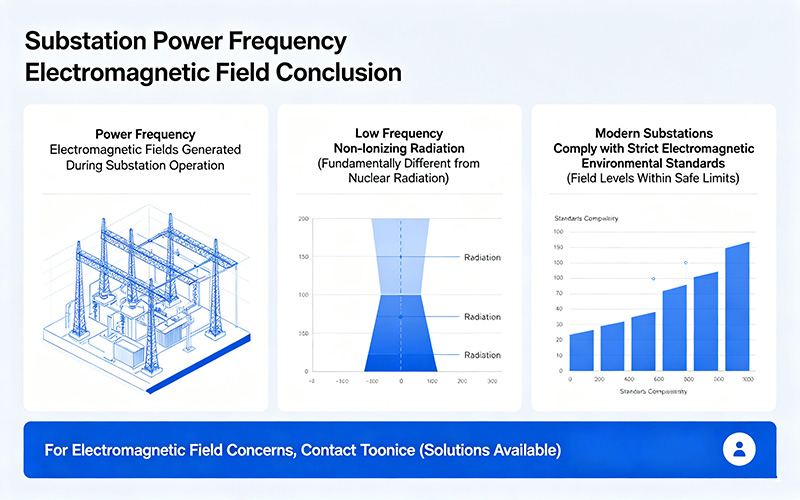
Substations do generate power frequency electromagnetic fields during operation, although these fields belong to low frequency non ionizing radiation, which differs fundamentally from nuclear radiation.
Modern substations are designed and constructed according to strict electromagnetic environmental standards, which means that their electromagnetic field levels normally remain within safe limits.
If you have concerns about electromagnetic fields from substations, you can contact Toonice because the company can provide related solutions.
FAQs
Q: Do substations produce radiation?
They produce low frequency electromagnetic fields rather than nuclear radiation or ionizing radiation.
Q: Is it safe to live near a substation?
Yes, as long as the substation complies with national construction and environmental standards.
Q: Do electromagnetic fields weaken with distance?
Yes, electromagnetic field intensity usually decreases as distance increases.
Q: Do box type substations emit radiation?
Yes, they generate small amounts of power frequency electromagnetic fields that normally remain within safe limits.
Q: Are there national standards for electromagnetic fields from substations?
Yes, China has clear regulations for substation construction and electromagnetic environment monitoring.

--- END ---

MV & LV Equipment Manufacturer · Wenzhou, China
COMPANY
PRODUCTS
INDUSTRIES