


A Ring Main Unit (RMU) is one of the most critical components in modern medium-voltage distribution systems. It controls power flow, isolates faults quickly, and keeps the rest of the network running — all within a compact, sealed enclosure. This guide breaks down how RMUs work, what makes them different, and where they are used.
- Phone / WhatsApp:+86 157 0677 9792
- sales@toonice.com
-
English
How Does a Ring Main Unit (RMU) Function in Electrical Distribution Systems?
May 07,2026
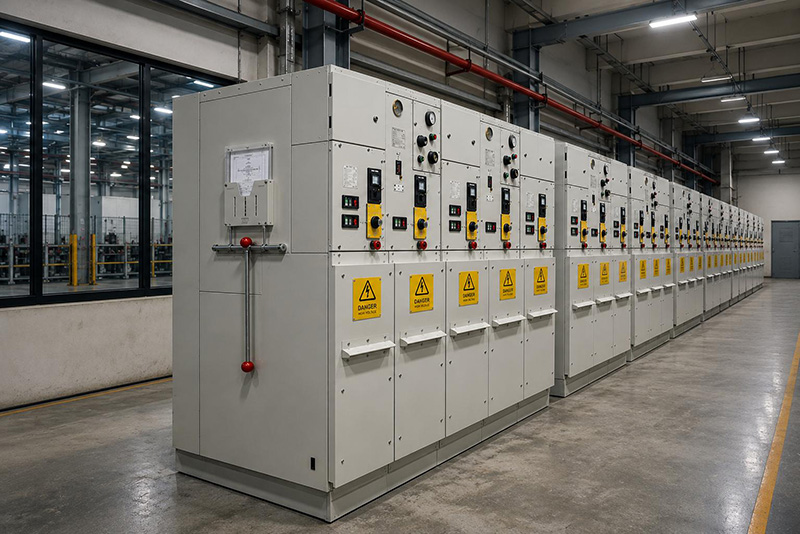
Principles of Ring Distribution Networks
Traditional radial networks deliver power in one direction from a central source. If a fault occurs, the entire downstream section loses supply. A ring distribution network solves this by forming a closed loop — each branch can receive power from two directions.
Example of a traditional radial distribution structure:
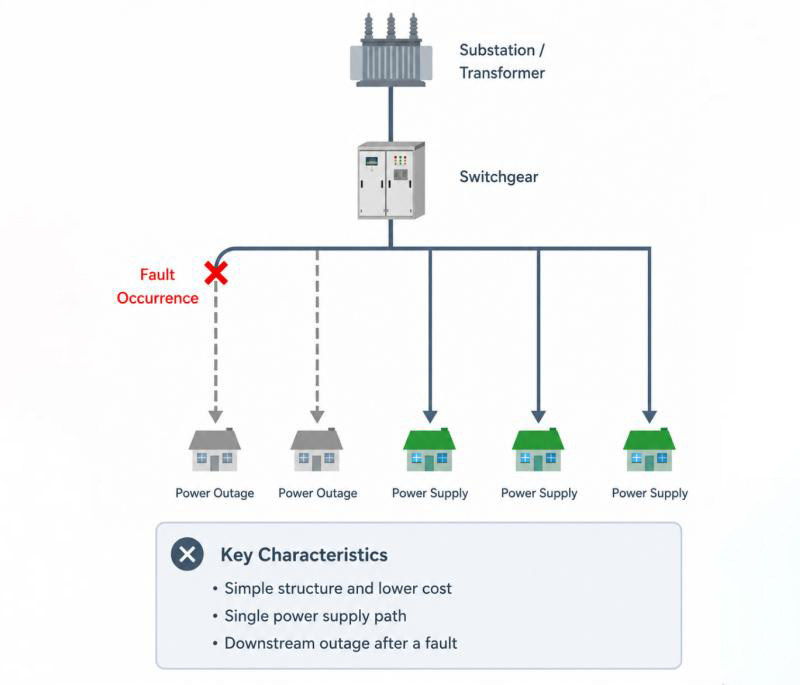
This redundancy means that if one path fails, the other path automatically supplies power, drastically reducing outage time. The RMU sits at key points in this loop, enabling fast switching between supply paths and isolating faults without disrupting the rest of the network.
Example of Ring Distribution Network with Alternative Supply Paths:

Main Components and Operation Mechanism of RMU
Key Components
An RMU typically contains the following components:
1. Load Switches

These are used for normal switching operations to connect and disconnect circuits under standard operating conditions.
2. Circuit Breakers

These provide protection by disconnecting the circuit in case of overloads or short circuits, preventing damage to the network.
Busbars and Metering Units:
Busbars enable internal power distribution, while metering units monitor electrical parameters like voltage and current for diagnostics.


These components function together to ensure that the RMU can handle its tasks, including power distribution, protection, and fault management, all within a safe and sealed enclosure that is easy to maintain.
How They Work Together
Under normal conditions, the RMU connects the power network to transformers or load circuits seamlessly. When a fault occurs, the protection system — circuit breakers or fuses — triggers automatically to isolate the faulty section. Power is then switched to the alternative path in the ring, allowing the rest of the network to continue operating with minimal interruption.
Types of RMUs: Side-by-Side Comparison
RMUs are classified by their insulating medium. Each type has distinct characteristics that make it suitable for different project conditions:

Air-Insulated RMU (AIS)
Compact and cost-effective solution for standard distribution systems.

SF6 Gas-Insulated RMU (GIS)
Fully sealed gas-insulated structure for compact urban applications.

Solid-Insulated RMU (SIS)
Eco-friendly solid insulation with low maintenance requirements.
| Aspect | Air-Insulated (AIS) | SF6 Gas-Insulated (GIS) | Solid-Insulated | Best For |
| (SIS) | ||||
| Insulation | Air | SF6 gas | Epoxy resin | |
| Footprint | Larger | Compact | Compact | Urban / space-limited sites → GIS or Solid |
| Environmental Resistance | Moderate | High (sealed) | High (sealed) | Coastal / industrial / humid → GIS or Solid |
| Initial Cost | Lower | Higher | Medium | Budget-sensitive projects → AIS |
| Maintenance | Standard | Specialist required | Low | Limited maintenance resources → Solid |
| Environmental Impact | Air | SF6 is high-GWP gas | None | Sustainability priority → Solid |
| Typical Application | Larger | Urban, underground, coastal | Urban, indoor, eco-sensitive |
Key Advantages of RMUs
RMUs offer several benefits in electrical distribution systems:
- Reliability of Power Supply: The ring distribution structure, combined with the RMU, minimizes the risk of power outages by providing multiple power supply paths.
- Space Efficiency: RMUs are compact, making them well-suited for urban installations, especially in areas with limited space, such as underground facilities.
- Simplified Installation and Lower Maintenance Effort: The modular design simplifies installation and maintenance, lowering associated costs.
- Adaptability in Harsh Environments: Gas or solid insulation options make RMUs effective even in harsh operating environments.
Typical Applications

RMUs are widely used in various medium-voltage distribution scenarios, such as:
- Urban residential areas and commercial buildings: These locations rely on RMUs to provide consistent power even in high-demand environments.
- Industrial parks and large commercial facilities: In these settings, RMUs help ensure the continuous operation of power systems, preventing downtime in operations.
- Underground cable distribution and renewable energy integration: RMUs link renewable energy sources, such as solar and wind, with the main power grid, ensuring smooth power distribution.
In addition to these applications, RMUs are also integrated into smart systems for remote monitoring and control, improving operational efficiency and providing valuable insights into system performance.
Our GIS RMU Solution
For projects that demand compact size, strong environmental resistance, and minimal on-site installation work, our GIS Ring Main Unit is purpose-built for these requirements. Factory-assembled and fully tested before shipment, it is ready for fast deployment and consistent performance across a wide range of site conditions.

Our GIS RMU is well-suited for urban distribution networks and underground substations, while also supporting reliable operation under high-temperature and desert environmental conditions.
→ Read the Saudi Arabia RMU Project Case Study
Conclusion
The Ring Main Unit is vital in medium-voltage distribution systems, helping to stabilize and strengthen the power network. Its compact design, flexible control features, and adaptability make it suitable for various applications in both traditional power grids and modern smart energy networks.
Selecting the right RMU type — based on space constraints, environmental exposure, budget, and maintenance capability — directly determines the reliability and cost-effectiveness of your distribution system over its full operational life.
Not sure which RMU is right for your project?
Our engineering team can review your site conditions and recommend the most suitable solution — at no obligation.

--- END ---

MV & LV Equipment Manufacturer · Wenzhou, China
COMPANY
PRODUCTS
INDUSTRIES