- Phone / WhatsApp:+86 157 0677 9792
- sales@toonice.com
-
English



Seven Differences Between Pole Mounted Transformers and Pad Mounted Transformers
Jun 20,2026
Pole mounted transformers and pad mounted transformers are two common types of distribution transformers in power distribution systems. A pole mounted transformer is usually installed on top of a utility pole and is used in overhead distribution networks.
A pad mounted transformer is installed on a concrete base at ground level and uses an enclosed cabinet design, which suits underground distribution systems and areas with higher public activity.
Both transformer types are used for voltage conversion and power distribution. They differ in installation method, safety, maintenance requirements, space use, and cost.
This article explains the seven main differences between pole mounted transformers and pad mounted transformers to help you choose a suitable distribution solution.
Key Takeaways
- Pole mounted transformers are installed on utility poles, while pad mounted transformers are installed on ground level foundations.
- Pad mounted transformers offer higher safety and suit areas with higher public activity.
- Pole mounted transformers have lower initial investment and relatively lower maintenance costs.
- Pad mounted transformers have a cleaner appearance and suit underground distribution and urban construction projects.
Installation Location and Installation Method
Pole mounted transformers are usually installed on top of utility poles. They are fixed to distribution poles with brackets and connected to overhead power lines.
This installation method uses vertical space and reduces the need for ground level facilities. It is widely used in rural areas, suburbs, and places where overhead distribution networks are common. The installation process is relatively simple, and the construction period is usually short.
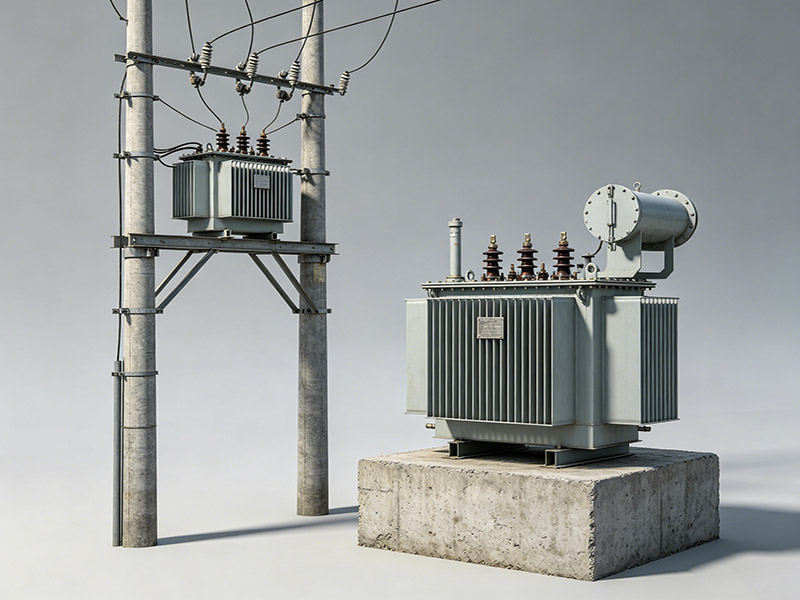
Pad mounted transformers are installed on concrete bases or prefabricated platforms at ground level. They are usually used with underground cable systems.
Common installation sites include residential communities, commercial areas, schools, and industrial parks. Since the installation requires foundations and underground cable channels, the work is more complex. The overall layout is cleaner and more suitable for planned urban spaces.
Appearance and Structure
Pole mounted transformers usually have a cylindrical or tank shaped structure. They are smaller in size and installed above the ground.
The outer shell is often a sealed steel oil tank, while the inside contains windings, a core, and insulating oil. Since this type is mainly designed for overhead lines, its structure is compact, which makes lifting and installation easier.
Pad mounted transformers use a rectangular metal cabinet design and are installed at ground level. The cabinet usually integrates the transformer, high voltage switchgear, and low voltage distribution equipment into one unit.
The enclosure is often made with corrosion resistant materials and provides protection against water, dust, and damage. Its appearance is cleaner and more suitable for public areas.
Safety Performance
Pole mounted transformers are installed at a higher position, so the public has limited access to them. This reduces the risk of accidental electric shock. Since the equipment is exposed outdoors, it can be affected by lightning, falling trees, or severe weather. External protective devices help support safe operation.
Pad mounted transformers use a fully enclosed design. High voltage and low voltage components are locked inside a metal cabinet. The public cannot directly access live parts, which gives this design a higher level of safety. This type suits schools, commercial areas, and residential communities where people often pass nearby.
Maintenance Difficulty
Maintenance of pole mounted transformers usually requires lifting equipment or aerial work platforms. Technicians need to inspect and repair the unit at height.
Although the equipment structure is relatively simple, working above ground increases maintenance difficulty and safety management requirements. Bad weather can also limit maintenance work.
Pad mounted transformers are installed at ground level, so maintenance workers can access the equipment directly. After opening the cabinet door, technicians can inspect the internal components without using aerial work equipment.
Although the internal structure is more complex, maintenance is usually more efficient, especially in locations that require regular inspection.
Space Occupation
Pole mounted transformers are installed on utility poles, so they do not require extra ground space. This makes them a cost effective option for areas with limited land or areas where open ground space should be preserved. They are widely used in rural and remote areas.
Pad mounted transformers require a dedicated foundation and proper safety clearance, so they occupy a certain amount of ground space. In urban planning, an installation area usually needs to be reserved.
Although they take up more ground space, their neat layout helps improve the appearance of the surrounding environment.
Environmental Adaptability
Pole mounted transformers can adapt to many outdoor environments, especially rural areas, mountain regions, and places covered by overhead lines. Since they are exposed to sunlight, rain, snow, wind, and dust for long periods, their enclosure and insulation system need good weather resistance.
Pad mounted transformers use a sealed cabinet structure, which provides good protection against rain, dust, and pollutants. They also have strong corrosion resistance and environmental adaptability.
This makes them suitable for cities, coastal areas, and underground distribution systems where the operating environment can be more complex.
Cost Investment
Pole mounted transformers usually have a lower equipment price. Their installation process is simple and does not require a dedicated foundation, so the initial investment is lower. For projects with limited budgets or lower distribution loads, this type offers good economic value.
Pad mounted transformers have higher equipment costs. They also require concrete foundations, underground cable systems, and supporting protection facilities, so the total investment is higher than that of pole mounted transformers. Their safety and appearance advantages can provide value during long term operation.
Conclusion
Pole mounted transformers and pad mounted transformers can both provide reliable power distribution, while they suit different application environments. Pole mounted transformers have lower costs and easier installation, so they are more suitable for rural areas and overhead distribution systems.

Pad mounted transformers provide higher safety and a cleaner appearance, so they are more suitable for cities, commercial areas, and underground distribution networks. Selection should be based on installation environment, safety requirements, budget, and maintenance needs.
FAQs
Q1 Which is safer, a pole mounted transformer or a pad mounted transformer?
Pad mounted transformers usually provide higher safety because they use a fully enclosed cabinet design.
Q2 Where are pole mounted transformers commonly used?
They are mainly used in rural areas, suburbs, and overhead distribution systems.
Q3 Why are pad mounted transformers more expensive?
They have a more complex structure and require underground cables and foundation construction.
Q4 Which transformer is easier to maintain?
Pad mounted transformers are easier to maintain because they are installed at ground level.
Q5 Which transformer is commonly used in urban distribution systems?
Modern cities and residential communities usually prefer pad mounted transformers.

--- END ---

MV & LV Equipment Manufacturer · Wenzhou, China
COMPANY
PRODUCTS
INDUSTRIES