- Phone / WhatsApp:+86 157 0677 9792
- sales@toonice.com
-
English

VFD Panel vs. Soft Starter Panel: Which One Should You Choose?
Oct 08,2026
How VFDs and Soft Starters Control Motors
A soft starter limits the voltage during acceleration and lets the motor run at line frequency once it reaches speed. Its work lasts seconds. After that, a bypass contactor takes over and the device stops carrying current.
A VFD rectifies the supply, rebuilds it at a chosen frequency, and keeps the motor under continuous control. Its work lasts the whole shift, since speed, torque, and acceleration stay adjustable while the machine runs.
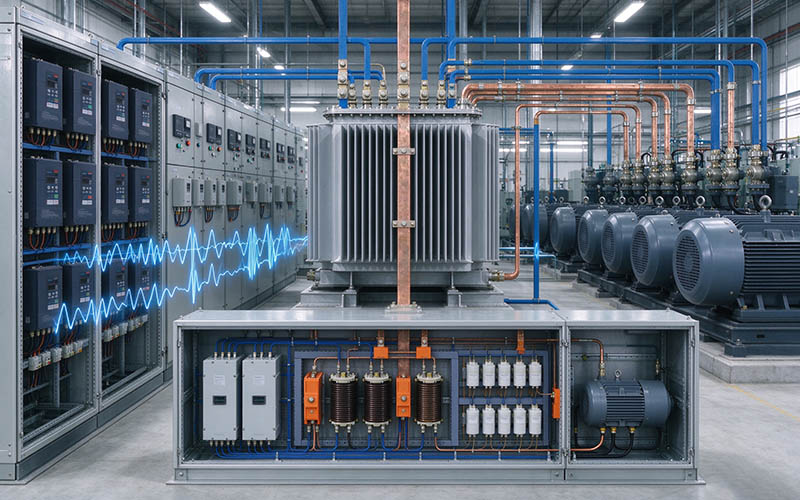
The panel around each device carries the same duties: protection, isolation, control interface, and cooling. What differs is the footprint of the drive, the heat it produces, and the cable and earthing rules that come with a variable frequency output. Our notes on low voltage cabinet assemblies cover how those panels go together.
Decide by the Load and the Process
The load tells you which device pays. Process control tells you whether a soft starter is enough.
| Load and Process | Soft Starter Panel | VFD Panel |
|---|---|---|
| Pump with a valve controlling flow | Adequate | Wastes energy saved by throttling |
| Pump on pressure or flow control | Starting only | Speed control pays back |
| Fan with damper control | Adequate | Better on variable demand |
| Conveyor with variable product rate | Poor fit | Speed control needed |
| Compressor with fixed demand | Adequate | Useful only on load variation |
| Crusher or mill on frequent starts | Protects the motor | Speed control may help throughput |
Where the process needs a valve or damper to throttle a machine that then runs at full speed, a soft starter is the right answer. A VFD on that duty does the same job with extra electronics and a harmonic load. Where the process varies, the VFD removes the throttle and the energy saving usually pays back the difference.
What the Panel Adds Around the Device
The device is one component in a cabinet that has to protect it, feed it, and let an operator control it. Both panel types run from 380 V to 480 V with insulation rated to 690 V, local, remote, or automatic control, and a Modbus or industrial Ethernet interface.
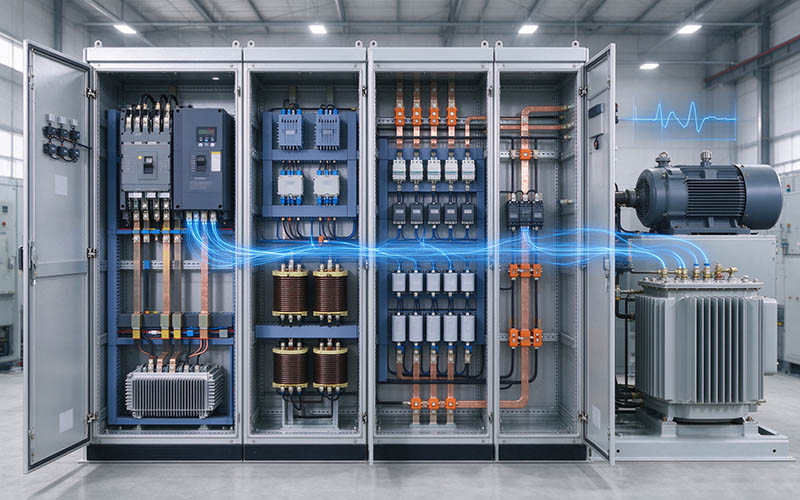
A soft starter panel adds a bypass contactor, which takes the device out of circuit after acceleration and removes its losses during running. It also carries adjustable starting parameters, so an engineer can set initial voltage, current limit, and ramp time for the specific load. Where the panel also has to handle logic and interlocks, a PLC control panel can take that duty.
A VFD panel adds forced air cooling, because a drive produces more heat than a starter of the same rating. It also needs a speed reference from a keypad, an analog signal, or a communication command. A bypass remains optional, and on some processes, it is the difference between running and standing still when the drive needs service.
| Configuration Item | Soft Starter Panel | VFD Panel |
|---|---|---|
| Starting device | Soft starter | Variable frequency drive |
| Bypass | Contactor, standard | Optional |
| Cooling | Natural in most ratings | Forced air |
| Speed reference | Not applicable | Keypad / analog / network |
| Typical enclosure | IP30 / IP40 / IP54 | IP30 / IP40 / IP54 |
| Control mode | Local / remote / automatic | Local / remote / automatic |
Both cabinets are built as assemblies to the IEC 61439 series, and a VFD panel also has to satisfy the drive manufacturer requirements that apply to the installation. That second set of rules covers cable length, earthing, and the treatment of the motor cable, and skipping it is how drive failures begin.
Where Power Quality Enters
A soft starter draws a distorted current only during the ramp, then behaves like the motor it feeds. A VFD draws a non-sinusoidal current continuously, which adds harmonic content to the supply and can load the neutral and the transformer differently than the design assumed.
On a plant with a small supply transformer and a large drive population, that matters. Our notes on capacitor bank correction cover why capacitors and drives interact badly, and why correction equipment should not be switched with the drive running.
The practical step is to give the drive count and the motor ratings to whoever designs the supply before the board is ordered. Harmonic filters, a reactor, or a larger transformer can be added in the panel, but retrofitting them after commissioning costs more than designing them in.
Key Settings for Soft Starter Performance
Proper soft starter settings help reduce starting current, limit mechanical stress, and ensure smooth motor acceleration. The correct parameters depend on the motor characteristics, connected load, and operating conditions. Four settings deserve particular attention during commissioning.
Initial Voltage and Current Limit Settings
The initial voltage determines the starting torque available to the motor, while the current limit restricts the current drawn during acceleration. If the initial voltage is too low, the motor may struggle to accelerate under load. If it is too high, the motor may experience excessive starting torque and mechanical stress.
These settings should be adjusted according to the motor’s rated current and the starting torque required by the application. Current limiting must also allow sufficient torque for the motor to accelerate reliably.
Setting the Acceleration Ramp Time
Ramp time determines how gradually the soft starter increases the applied motor voltage during startup. The appropriate setting depends on the load inertia, starting torque requirements, and motor characteristics.
A ramp that is too short may cause abrupt acceleration and unnecessary mechanical stress. An excessively long ramp can extend the acceleration period, increasing motor heating and potentially triggering overload protection. The aim is to achieve smooth acceleration without unnecessarily prolonging the start.
Soft Stop Settings for Different Applications
The soft stop function gradually reduces the voltage supplied to the motor rather than disconnecting it immediately. This can be useful in pump applications, where a controlled reduction in motor torque may help reduce pressure surges and water hammer.
However, soft stopping is not necessary for every application. For conveyors and other equipment that require a defined stopping response, the stopping method should be selected according to the process requirements. A soft starter does not provide precise speed control during deceleration.
Bypass Contactor and Restart Protection
Many soft starter panels use a bypass contactor to carry motor current after startup, reducing power losses and heat generation in the soft starter.
During commissioning, verify that the bypass contactor operates correctly and that the control system responds safely to overloads, faults, and power interruptions. Particular attention should be given to automatic restart settings and the behavior of the panel when power is restored.
Restart protection should be configured according to the application’s safety requirements to prevent unexpected motor operation after a fault or power failure.
Conclusion
The right choice depends on how the motor operates. If it runs at a fixed speed and only needs a controlled start, a soft starter panel is usually sufficient. It limits starting current and reduces mechanical stress without the added cost of a variable frequency drive.
A VFD panel makes more sense when motor speed needs to change during operation. This is common in pumps, fans, and conveyors where speed adjustment is part of the process. Before selecting either panel, check the motor rating, load characteristics, starting frequency, and operating conditions. For custom panel configurations, visit our motor control center panels or contact the Toonice technical team.

--- END ---

MV & LV Equipment Manufacturer · Wenzhou, China
COMPANY
PRODUCTS
INDUSTRIES