- Phone / WhatsApp:+86 157 0677 9792
- sales@toonice.com
-
English
Withdrawable vs. Fixed Switchgear: Key Differences and How to Choose
Oct 12,2026
Choosing between withdrawable and fixed switchgear involves more than comparing purchase prices. Both designs can provide reliable power distribution, but they differ in equipment accessibility, maintenance procedures, installation requirements, and overall cost.
Withdrawable switchgear allows compatible switching devices to be moved into test or disconnected positions and, where designed for it, removed for inspection or replacement. Fixed switchgear uses permanently mounted devices, typically with a simpler mechanical arrangement and lower initial cost. The better option depends on the electrical ratings, maintenance requirements, available space, and the consequences of taking equipment out of service.
For facilities where downtime is costly or equipment needs regular servicing, withdrawable switchgear may offer practical advantages. In applications with less frequent maintenance and tighter budgets, fixed switchgear may be sufficient. Understanding these differences helps engineers and project owners select equipment that meets both operational and financial requirements.
What Actually Changes Between the Two Designs
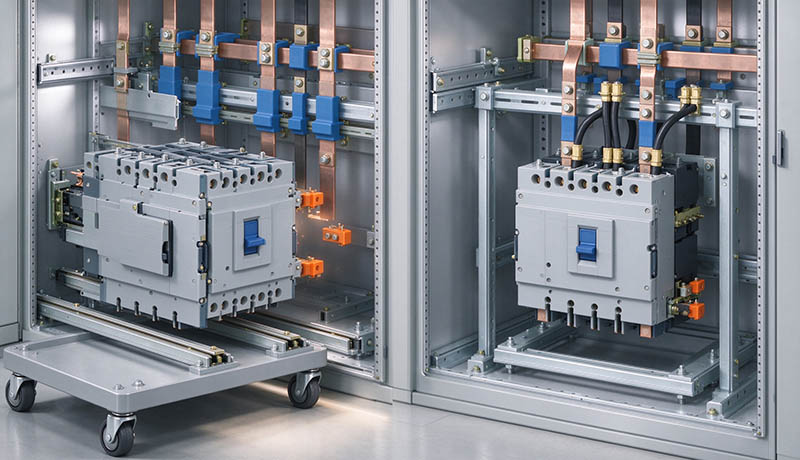
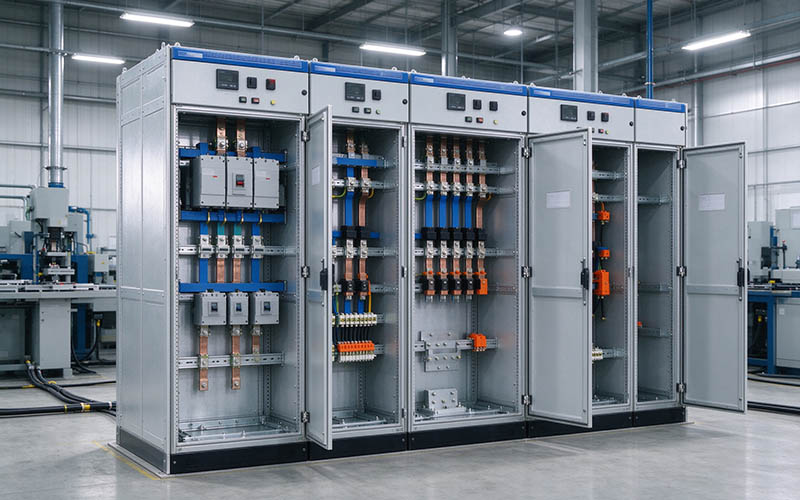
A withdrawable assembly houses each functional unit in its own compartment on a trolley. The breaker or starter slides out on rails, the primary contacts separate behind a shutter, and the unit leaves the board without touching the busbar. A fixed assembly bolts the device to the frame. The cables come off first, then the device comes out, and the busbar stays live unless the whole section is isolated.
That mechanical difference drives everything else, from floor area to the maintenance routine to the spare hardware a plant keeps.
Downtime and Maintenance Decide More Than Price
A withdrawable unit comes out in minutes. A fixed unit takes an electrician, a permit to work, and enough isolation to make the section safe, which means the neighboring feeders lose supply as well. On a motor control center with thirty starters, that difference repeats every time a contactor fails.
| Point | Withdrawable | Fixed |
|---|---|---|
| Unit replacement | Slide out, slide in | Disconnect, unbolt, rewire |
| Supply interruption | Unit only | Whole section |
| Spare strategy | Keep complete units | Keep devices and rebuild |
| Panel footprint | Larger per circuit | Smaller per circuit |
| Typical rating ceiling | 6300 A | 3150 A |
| Operator skill | Racking procedure trained | Wiring work trained |
The rating ceiling in that table comes from the current product lines. Withdrawable assemblies reach 6300 A with a short-time withstand of 65 kA for one second, while the fixed range reaches 3150 A at 50 kA for one second and a peak of 105 kA.
Total Cost of Ownership: Withdrawable vs. Fixed Switchgear
The purchase price is only part of the total cost of switchgear ownership. Maintenance, equipment replacement, and production downtime can add significant expenses over time. Downtime costs are often overlooked during procurement because they fall under production losses rather than maintenance budgets.
| Cost Driver | Withdrawable | Fixed |
|---|---|---|
| Purchase price | Higher per circuit | Lower per circuit |
| Floor space | Larger footprint | Smaller footprint |
| Spare holding | Complete units in store | Devices and parts |
| Intervention time | Minutes per unit | Hours per section |
| Production risk | Limited to one unit | Whole section down |
| Training | Racking procedure | Wiring and isolation |
When comparing withdrawable and fixed switchgear, consider maintenance frequency and the cost of unplanned shutdowns. Fixed switchgear is often more economical for applications with infrequent maintenance and low downtime costs. Withdrawable switchgear can simplify component replacement and reduce maintenance-related downtime, depending on the equipment design and isolation arrangements.
Fixed switchgear generally offers lower initial costs and simpler construction, making it suitable for lighting and general power distribution. Withdrawable switchgear is worth considering where frequent maintenance, faster component replacement, and service continuity are priorities.
When to Choose Withdrawable Switchgear
Withdrawable switchgear is well suited to motor control centers (MCCs) and facilities where equipment availability is critical. Removable units allow faster replacement of faulty starters or contactors, helping reduce maintenance downtime. This can be particularly useful in hospitals, data centers, and water treatment plants where continuous operation is important.
Large distribution systems with multiple incoming feeders or bus sections may also benefit from withdrawable designs. With suitable compartmentalization and isolation arrangements, individual units can be serviced without shutting down the entire switchboard. Keeping compatible spare units available can further reduce repair time.
When to Choose Fixed Switchgear
Fixed switchgear is a practical option for installations with stable loads and limited maintenance requirements. Small industrial facilities, workshops, and general distribution boards often benefit from its lower initial cost and simpler construction.
Fixed designs also have fewer moving parts and do not require racking mechanisms, which can simplify maintenance and operator training. For projects where equipment is serviced infrequently or maintenance resources are limited, fixed switchgear can provide a cost-effective and reliable solution.
Matching the Choice to the Load
Look at the duty, not the nameplate. A board full of motor starters has a maintenance profile that withdrawable design serves well, which is why the motor control configuration is a standard layout for that product line. A board that splits a supply into feeder circuits has almost no maintenance profile at all, and a fixed frame does the job.
Where both duties meet in one room, mix them. A withdrawable incomer and bus coupler with fixed outgoing feeders is a common compromise, and it keeps the expensive mechanism where the switching actually happens. The GCS withdrawable line and the GDF fixed compartmentalized cabinet are built for exactly that mix.
Form of Separation and Electrical Rating Requirements
The form of separation affects both switchgear construction and cost. Higher levels of internal separation require additional barriers, cable compartments, and assembly work, regardless of whether the switching devices are fixed or withdrawable.
When comparing quotations, make sure both designs meet the same separation requirements. A fixed switchboard with extensive internal compartmentalization may cost nearly as much as a basic withdrawable design. The final cost depends on the enclosure arrangement, component selection, and project specifications.
Frequently Asked Questions
Is withdrawable switchgear always better than fixed?
No. Withdrawable wins where devices fail often or the supply cannot be interrupted. Fixed wins where the load is stable and floor space and cost matter more than swap time.
How long does it take to replace a unit in each design?
A withdrawable unit comes out in minutes using the racking handle. A fixed device needs the section isolated, cables disconnected, and the device unbolted, which usually takes hours and affects adjacent circuits.
Can a fixed cabinet be upgraded to withdrawable later?
Not in practice. The frame, busbar, and compartment structure are different, so an upgrade means a new assembly rather than a conversion of the old one.
Which design handles higher fault levels?
Withdrawable assemblies reach higher ratings in the current range, up to 6300 A with 65 kA for one second. Fixed cabinets cover up to 3150 A at 50 kA for one second, which suits most distribution duty.
What should I send with an enquiry?
Send the single-line diagram, the load schedule, the fault level at the board, and the required form of separation. Those four items settle the design, and the quotation then compares like with like.
Conclusion
Write the maintenance plan before choosing the frame. If the plan says a starter will be swapped during production, the board has to allow it. If the plan says maintenance happens during a planned shutdown, a fixed frame does the same job for less money.
The MNS type withdrawable switchgear covers motor control and distribution duty up to 6300 A, and the GGD fixed switchgear covers distribution up to 3150 A. Both are built to IEC 61439-1 and IEC 61439-2, so the choice rests on the plant rather than on the standard.
Talk to our engineers: send the board schedule and the fault level and we will recommend the frame, the ratings, and the form of separation.

--- END ---
Already the last article
Next: VFD Panel vs. Soft Starter Panel: Which One Should You Choose?

MV & LV Equipment Manufacturer · Wenzhou, China
COMPANY
PRODUCTS
INDUSTRIES