- Phone / WhatsApp:+86 157 0677 9792
- sales@toonice.com
-
English
Advantages of Ground-Mounted Transformers in Modern Distribution Systems
Jun 16,2026
A ground-mounted transformer, also known as a Ground-Mounted transformer, is an enclosed distribution transformer installed on a concrete base at ground level.
It is widely used in residential areas, commercial parks, industrial facilities, and public infrastructure. It uses a strong steel enclosure to safely convert medium-voltage electricity into low-voltage power for end users.
With high safety, compact installation, easy maintenance, and strong environmental adaptability, ground-mounted transformers have become a core part of modern underground distribution systems.
This article introduces the main advantages, application areas, and selection factors of ground-mounted transformers.
Key Takeaways
- Ground-mounted transformers safely and efficiently complete voltage conversion in distribution systems.
- Fully enclosed structures improve safety for people and equipment.
- They are widely used in residential, commercial, industrial, and public facility projects.
- Capacity, voltage rating, site conditions, and safety requirements should be considered during selection.
What Is a Ground-Mounted Transformer?
A Ground-Mounted transformer is a distribution transformer installed on a ground-level prefabricated base. It usually uses a fully enclosed and tamper-resistant design. Its high-voltage and low-voltage connections are placed inside a locked cabinet, which helps prevent accidental contact with electrical equipment.
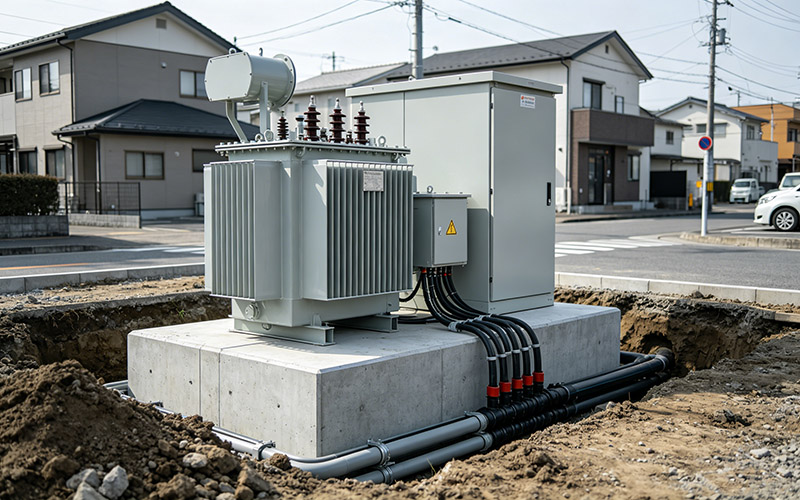
Compared with traditional pole-mounted transformers, Ground-Mounted transformers do not need overhead installation. They have a cleaner appearance and can work with underground cable systems.
Because of their compact structure and reliable safety design, they are widely used in urban distribution networks, residential communities, commercial centers, and industrial parks.
Why Are Ground-Mounted Transformers Widely Used?
Improving Distribution System Safety
One major advantage of ground-mounted transformers is their strong safety performance. Since the equipment uses a fully enclosed metal housing, both high-voltage and low-voltage components are safely isolated, which helps prevent accidental contact with live parts.
At the same time, tamper-resistant locks and strong enclosures reduce the risk of unauthorized operation and damage. In areas with frequent public access, such as residential communities, schools, and commercial streets, this design improves the overall safety level of the power distribution system.
Supporting Underground Distribution Networks
As urban development continues, more regions are using underground cable systems. Ground-mounted transformers can work directly with underground distribution networks and deliver stable power from main distribution lines to end users.
Compared with overhead line systems, underground distribution networks create a cleaner visual environment and reduce the effect of severe weather on power reliability. For this reason, ground-mounted transformers have become a common choice in modern urban power grid construction.
Improving Power Supply Reliability
Stable electricity supply supports daily life, business activity, and industrial production. Ground-mounted transformers use a sealed structural design, which helps keep dust, moisture, and pollutants away from internal components and reduces the chance of failure.
Their structure can also handle many environmental conditions, including high temperature, low temperature, rain, snow, and humid coastal areas. Higher equipment reliability means fewer outages and lower maintenance costs.
Optimizing Land Use and Urban Appearance
Equipment appearance and space use matter more in modern city planning. Ground-mounted transformers are installed at ground level and take up limited space, so they do not require extra pole structures.
Their compact design allows them to fit more naturally into communities, parks, and commercial areas. When used with underground cables, they also reduce visual clutter and help improve the overall appearance of urban spaces.
Where Are Ground-Mounted Transformers Used?
Residential Community Distribution
Residential communities are one of the most common application areas for ground-mounted transformers. Modern housing projects often use underground cable distribution systems to improve safety and appearance.
Ground-mounted transformers convert medium-voltage electricity into low-voltage power for daily residential use, while also supplying public lighting and community facilities. Their low-noise operation and enclosed design make them suitable for densely populated residential areas.
Commercial Buildings and Shopping Centers
Commercial facilities need a stable power supply to support daily operations. Shopping centers, office buildings, and hotels rely on electricity for lighting, air conditioning, elevators, and information systems.
Ground-mounted transformers provide stable voltage output and are easy to maintain, which helps reduce economic losses caused by power interruptions. Because of this, they are often used in commercial distribution systems.
Industrial Parks and Manufacturing Facilities
Industrial production usually requires large electrical loads and continuous power supply. Ground-mounted transformers can provide suitable voltage levels based on the needs of industrial equipment, production lines, machinery, and automation systems.
Their durable structure allows them to work in complex industrial environments. This helps companies maintain production efficiency and improve power supply stability.
Public Infrastructure Projects
Airports, hospitals, schools, data centers, and transportation hubs all depend on stable electricity supply. Ground-mounted transformers support the daily operation of these facilities and provide reliable power distribution capacity.
In places such as hospitals and data centers, reliable power equipment helps maintain service continuity and reduce the risk of operational disruption.
Factors to Consider When Choosing a Ground-Mounted Transformer
Transformer Capacity
Choosing the right capacity helps keep the power supply stable. Users should determine the rated capacity based on actual load demand and future expansion plans, which helps avoid overload caused by insufficient transformer capacity.
Voltage Rating Requirements
Power distribution standards vary by region and project. During selection, users should confirm whether the primary and secondary voltage ratings match local grid standards and actual application needs.
Installation Environment
Environmental conditions directly affect equipment life and operating performance. Temperature, humidity, salt spray, dust, and flood risk should be reviewed before choosing the proper protection level and insulation configuration.
Safety and Standard Certification
High-quality products usually meet IEEE, ANSI, IEC, and other international standards. Certified equipment can improve operating safety, support long-term reliable operation, and make maintenance easier.

Conclusion
Ground-mounted transformers have become a core part of modern distribution systems because of their safety, reliability, and environmental adaptability. Whether used in residential communities, commercial buildings, or industrial facilities, they provide stable and efficient power distribution solutions.
Toonice offers many high-quality ground-mounted transformers. Visit our homepage to learn more or request a consultation.
FAQs
Q1 What is the difference between a ground-mounted transformer and a pole-mounted transformer?
A ground-mounted transformer is installed at ground level with an enclosed structure, while a pole-mounted transformer is installed on a utility pole and is mainly used in overhead distribution systems.
Q2 Are ground-mounted transformers safe?
Yes. Their fully enclosed and tamper-resistant design helps prevent contact with live parts and improves operating safety.
Q3 Can ground-mounted transformers be used in underground distribution systems?
Yes. They are designed for underground cable networks and are widely used in modern urban distribution systems.
Q4 Do ground-mounted transformers need frequent maintenance?
Usually, they do not. Their sealed structure and weather-resistant design help reduce maintenance frequency and operating costs.
Q5 How do I choose a suitable ground-mounted transformer?
You should consider load capacity, voltage rating, installation environment, and relevant industry standards and certifications.

--- END ---

MV & LV Equipment Manufacturer · Wenzhou, China
COMPANY
PRODUCTS
INDUSTRIES