- Phone / WhatsApp:+86 157 0677 9792
- sales@toonice.com
-
English
Understanding the Switchgear Basics and Benefits
Jun 14,2026
Switchgear is part of an electrical power system used to control, protect, and isolate circuits so that electricity can be transmitted across different voltage levels in a stable and safe way.
It is made up of circuit breakers, disconnect switches, fuses, and protection devices. It is widely used in generation systems, transmission and distribution networks, and industrial power systems.
Its function is to support stable operation of electrical systems while reducing the impact of faults on equipment and operators. This article explains how switchgear works, what it does, and how it is used in power systems.
Key Takeaways
- Switchgear controls, protects, and isolates electrical circuits
- It improves system stability and operational safety
- It consists of circuit breakers, busbars, and protection units
- It is used in industrial power systems, grids, and renewable energy networks
How switchgear works
Switchgear operates by switching electrical circuits on and off and separating faulty sections when abnormal conditions appear. It uses mechanical switching parts together with electrical protection systems to manage current flow during both normal and fault conditions.
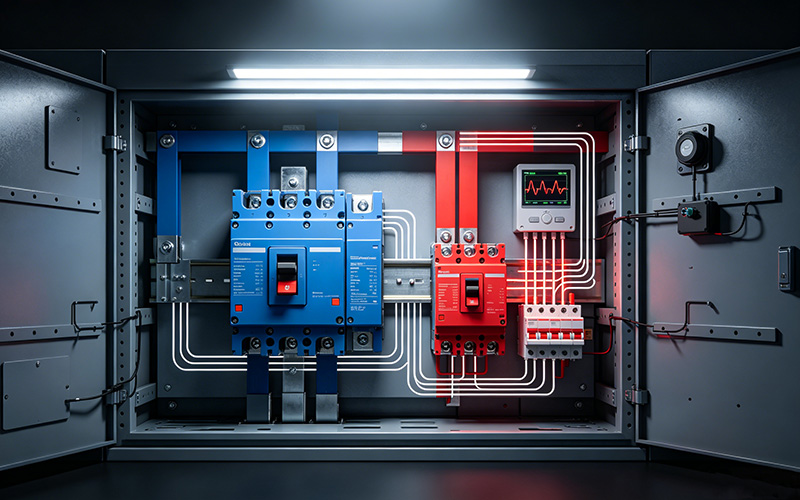
When a fault occurs, the system interrupts the current flow and isolates the affected section so that damage does not spread. Modern systems also use sensors and monitoring units that track electrical conditions in real time and support automated responses.
Why switchgear matters in power networks
Switchgear acts like a control point in a power network. It manages how electricity is distributed and separates sections of the grid when faults occur. Without this separation, a local fault can affect a wider area of the system.
Power networks would not operate in a stable structure without this type of circuit control, since each section would be directly exposed to system-wide disturbances.
Protection functions of switchgear
Overload protection
When current exceeds the rated level, switchgear responds by triggering a circuit interruption through a breaker. This prevents overheating in cables and reduces the risk of equipment damage.
In industrial distribution systems, overload conditions often occur during sudden load changes, so this function helps maintain stable operation under variable demand conditions.
Short circuit protection
When a short circuit happens, current rises rapidly within a very short time. Switchgear responds by disconnecting the circuit within milliseconds. This limits electrical stress on connected equipment and reduces the chance of cascading damage.
The response depends on the coordination between breakers and protective relays, which detect abnormal current levels and initiate disconnection.
Insulation and isolation protection
Switchgear uses physical separation and insulating materials to keep live parts isolated from maintenance personnel. This allows inspection and repair work to be carried out without direct exposure to energized components.
Proper insulation design also reduces leakage current and supports stable operation under high voltage conditions.
Maintenance and testing of switchgear
Routine inspection and condition monitoring
Switchgear requires regular inspection to confirm that all components remain in working condition. This includes checking contact wear, insulation condition, and mechanical movement of switching parts.
Monitoring systems may also track temperature and load behavior. Regular inspection helps identify early signs of failure and reduces unexpected outages in power systems.
Electrical performance testing
Electrical testing includes insulation resistance testing, dielectric withstand testing, and contact resistance measurement.
These tests evaluate whether the equipment can handle operational voltage and current levels without breakdown. Testing results are used to confirm that the system can operate safely under load conditions.
Mechanical operation testing
Mechanical testing focuses on the movement of breakers and switching mechanisms. The goal is to confirm that switching actions occur smoothly and within expected time limits.
Test operations simulate opening and closing cycles to detect delays, stiffness, or mechanical wear that could affect system response during fault conditions.
Safety considerations for switchgear operation
Safety checks before operation
Before any operation, the system must be confirmed as fully de-energized and properly isolated. Grounding conditions must also be verified.
In field operations, voltage detection tools are used to confirm the absence of residual electrical energy. Warning signs and restricted zones are placed around the equipment area to prevent unintended access during operation.
Use of protective equipment
Operators must use insulated gloves, protective clothing, safety glasses, and insulated tools when working with switchgear. High voltage environments can generate arc flash events that release high energy in a very short time.
Protective equipment reduces exposure to electrical and thermal hazards. Equipment condition must be checked before use to avoid reduced protection due to wear or damage.
Following standard operating procedures
All operations must follow electrical industry standards and internal operating procedures. Each step is designed to maintain controlled switching conditions and reduce human error.
In complex power systems, a single incorrect action can affect multiple connected sections. Operators must complete training and follow verification procedures that require independent confirmation before switching actions are executed.
Conclusion: future development of switchgear technology
Switchgear systems are moving toward digital control, modular structure, and automated monitoring. As communication technologies and sensor systems are integrated into power infrastructure, switchgear will support more continuous condition tracking and faster response to system changes.
This supports more stable operation in modern power networks.

Toonice offers a wide variety of switchgear; please visit our homepage to browse and purchase.
FAQs
Q1 What is switchgear?
Switchgear is a system used to control, protect, and isolate electrical circuits in power networks
Q2 What does switchgear do in power systems?
It manages electricity distribution and separates faulty sections from the rest of the system
Q3 What components are included in switchgear?
It typically includes circuit breakers, disconnect switches, busbars, and protection devices
Q4 Does switchgear require maintenance?
Yes, it requires regular electrical and mechanical testing to maintain stable operation
Q5 What is the future direction of switchgear?
It is moving toward digital monitoring, automated operation, and modular design

--- END ---

MV & LV Equipment Manufacturer · Wenzhou, China
COMPANY
PRODUCTS
INDUSTRIES