NSYZC
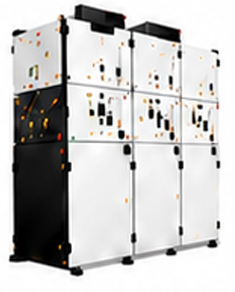
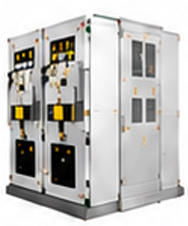
YZC new energy integrated photovoltaic prefabricated substation, European style all-in-one machine .
The European all-in-one machine includes an oil immersed transformer, a high-voltage room, a communication power cabinet, an inverter room, and a high-voltage room. The inverter room is placed on both sides of the transformer, and the communication power cabinet is placed next to the high-voltage room. The overall structure is in the shape of an eye, using a container as the fireproof insulation shell of the inverter room . The inverters in the inverter room are arranged in a mirror image, and there are lower entry wells between the inverter aisles . The side output of the inverter is connected to the low-voltage bushing on one side of the transformer through copper bars and flexible connections . Heat sinks and transformer instrument boxes are installed on both sides of the transformer. The transformer adopts an oil immersed load switch with a plug-in fuse core . The high-voltage fuse box, high-voltage bushing, and lightning arrester of the transformer are located in the high-voltage room, and the high-voltage bushing and cable are isolated from the fuse through a partition . The remote control monitoring room of the communication power cabinet is equipped with remote monitoring terminal equipment, auxiliary transformers, UPS, monitoring terminals and other devices . The secondary line inside the power cabinet is connected to the inverter room through a conduit between the high and low voltage chambers, and the transformer is cooled by natural air cooling (ONAN).
TOONICE’s the full name of the photovoltaic prefabricated cabin is prefabricated modular power distribution cabin for photovoltaic power stations. It is a standardized equipment cabin that integrates, debugs, and wires core functional equipment (such as inverters, combiner boxes, high-voltage cabinets, etc.) for “power conversion, control, protection, and monitoring” in photovoltaic power stations within a factory, before transporting the entire unit to the site for hoisting and positioning. Its core features are “factory prefabrication, modular integration, and on-site rapid installation”, which has completely transformed the traditional construction mode of photovoltaic power stations that relies on “on-site concrete foundation pouring and decentralized equipment installation”. It is a core equipment for the development of photovoltaic power stations towards “high efficiency, standardization, and intelligence”.
The power distribution system of traditional photovoltaic power stations undergoes processes like “site leveling → foundation pouring → equipment procurement → on-site wiring → commissioning”, with a construction period of 2–3 months. In contrast, 80% of the core work for photovoltaic prefabricated cabins (equipment integration, wiring, and commissioning) is completed in the factory. On-site, only 4 steps are needed: “foundation leveling → cabin hoisting → cable connection → grid-connected testing”. The installation cycle for a single cabin can be shortened to 1–2 weeks, and the overall construction period of the power station can be reduced by over 40%.
Standardized production processes (e.g., wiring in clean rooms, automated testing) are adopted in the factory, making equipment installation accuracy (such as cabinet spacing, terminal torque) and insulation performance more controllable. This avoids quality hazards (e.g., loose wiring, insulation damage) caused by on-site construction being affected by weather (rain, snow, high temperature) and variations in personnel skills. Meanwhile, the fully sealed design of the cabin reduces the erosion of equipment by on-site dust and moisture, lowering the equipment failure rate by 30%.
The cabin uses a high-strength steel structure (e.g., Q235B cold-rolled steel plate) + multi-layer protective coatings (anti-corrosion, sun protection, heat insulation), with a protection grade of up to IP54 and above (some models support IP65). It can adapt to complex environments such as extreme temperatures (-30℃ to 55℃), high altitudes (≤4000m), salt spray (coastal areas), and sand and dust (desert power stations), ensuring long-term stable operation of the equipment.
The layout of equipment inside the cabin is standardized (partitioned according to the process of “power generation → inversion → step-up → control”) and matched with an intelligent monitoring system (e.g., temperature and humidity sensors, equipment status indicator lights), allowing operation and maintenance personnel to quickly locate fault points (e.g., inverter alarms, abnormal current in combiner boxes). Some high-end models support “remote monitoring + automatic inspection” (e.g., checking the status of equipment in the cabin via cameras), reducing the frequency of on-site inspections and lowering annual operation and maintenance costs by 20%.
The structure of the photovoltaic prefabricated cabin is designed around three core aspects: “equipment integration, environmental control, and safety protection”. As a whole, it is divided into two major parts: “cabin shell” and “internal functional units”. The specific composition is as follows:
| Composition Parts | Specific Components | Core Functions |
| Cabinet Frame | 8MF cold-formed steel welded frame, panels, cabinetdoors | Provide mechanical support. The default protection class is lP30 (lP40customizable) to prevent the intrusion of solid foreign objects; the cabinet doolis equipped with a mechanical interlock to ensure that maintenance can only becarried out after power failure. |
| Core Functional Units | 1.Self-healing power capacitor | 1. Store and release reactive power. The capacity of a single unit is 10-30kvarand the total capacity is 60-600kvar; |
| 2. Intelligent compensation controller | 2. Serve as the core of monitoring and control to realize automatic switching, | |
| 3.Series reactor(optional) | 3.Suppress harmonics and protect capacitors; | |
| 4. Circuit breaker /contactor | 4. Realize circuit on-off and short-circuit protection. | |
| Auxiliary Components | 1. Temperature-controlled cooling fan | 1. Start automatically when the temperature inside the cabinet exceeds 40℃ toavoid high-temperature aging of capacitors; |
| 2. Voltage/ current transformer | 2. Collect power grid parameters and provide accurate data for the controller; | |
| 3. Terminal block | 3.Facilitate external cable connection and standardize wiring. |
TOONICE’s Photovoltaic prefabricated cabins, with the characteristics of “modularization and high adaptability”, are widely used in various types of photovoltaic power stations, especially suitable for scenarios with high requirements for construction efficiency and environmental adaptability::
① Manufacturing industry: Machine factories (lathes, milling machines), cement factories (ball mills, crushers), steel mills (steel rolling machines, fans), etc., compensate for the reactive power loss of inductive loads and improve the stability of production equipment;
2.Distributed Photovoltaic Power Stations:
① Industrial and commercial distributed: For photovoltaic projects on factory rooftops or in industrial parks, prefabricated cabins can be directly installed on rooftops or open spaces in the factory area, without occupying a large amount of land, and the installation period is short (it can be connected to the grid in 1-2 weeks) without affecting the normal production of the factory;
② Agrivoltaic / Fishery-photovoltaic complementary power stations: Photovoltaic panels are built above farmland or fish ponds, and prefabricated cabins are installed at the edge of the project to avoid damaging the cultivated land / fish ponds, while adapting to outdoor humid environments (IP54 protection).
① High-altitude power stations: Prefabricated cabins are equipped with inverters and air conditioners adapted to low air pressure (which can work normally at an altitude of 4000m) to prevent equipment from failing due to hypoxia and low temperature;
② Coastal power stations: Anti-corrosion steel structures (such as galvanized + fluorocarbon paint coating) and anti-salt-fog inverters are adopted to resist corrosion from sea breeze;
③ Power stations in cold regions: High-power heat blowers + thermal insulation layers are configured inside the cabin to ensure the normal startup of equipment in winter (minimum startup temperature -30℃).
| Item | Unit | High voltage electrical appliances | Transformer | Low Voltage Apparatus |
| Rated voltage | kV | 6/10 | 6/0.4 10/0.4 | 0.4 |
| Rated capacity | kVA | 50~1600 | ||
| Rated current | A | 200, 400, 630 | 100~3200 | |
| Rated short-circuit breaking current | A | load switch 400-630 | 15~63kA | |
| kA | The combination switch depends on the fuse |
|||
| Rated short-time withstand current | kA | 16, 20( 4s) | 15(1s) | |
| 30(1s) | ||||
| Rated peak withstand current | kA | 31.5, 50 | 30 | |
| 15~63kA | ||||
| Power frequency withstand voltage (1min) | kV | Relatively and alternately 32/42 | 25/35 (Oil immersed) |
≤ 0.3 , 2 |
| Isolation fracture 36/48 | 20/28 (Dry) |
< 0.3 , 2.5 | ||
| Lightning impulse withstand voltage (peak value) | kV | Relative and alternating 60/75 | 60/75 | |
| Isolation fracture 70/85 | ||||
| Box protection level | IP32 | |||
| Noise level | db | 55 | ||
| Execution standards | GB /T17467’High voltage and low voltage prefabricated substations’ | |||
| DL/T537’Technical Conditions for Ordering 6-3SkV B ox type Substations’ | ||||
Providing you with the most trusted energy solutions in an unpredictable world.
Contact Us
As a trusted manufacturer, we provide advanced equipment that supports the digital transformation and sustainability of the electrical grid.
Our carefully crafted product range meets the unique needs of different countries and clients.
More Products