- Phone / WhatsApp:+86 157 0677 9792
- sales@toonice.com
-
English
What are the Differences Between Metal Clad Switchgear and Metal Enclosed Switchgear
Jun 03,2026
Metal Clad Switchgear and Metal Enclosed Switchgear are two medium voltage switchgear structures used in power distribution systems. Both types place electrical components inside metal housings to control, protect and distribute electrical energy in industrial and commercial networks.
The difference is not in the function of power distribution but in how internal components are arranged, separated and maintained under operating conditions. This affects fault handling, maintenance behavior and system stability.
This article compares both types from structure, function, safety, application and cost perspectives.
Key Takeaways
- Metal Clad Switchgear separates internal components into independent compartments
- Metal Enclosed Switchgear uses a simplified internal structure with limited isolation
- Maintenance approach and fault behavior differ between the two designs
- Selection depends on system reliability requirements and project budget
What is Metal Clad Switchgear
Metal Clad Switchgear is designed with internal compartments that separate major functional units such as the circuit breaker, busbar system, cable connection area and protection devices. Each section is physically isolated by metal barriers.
The circuit breaker is typically a withdrawable unit. It can be moved in and out of the operating position without dismantling the entire panel. This allows service work to be carried out with reduced system interruption.
This structure is commonly used in medium voltage distribution systems where continuity of supply and controlled fault behavior are required, such as substations, industrial power networks and large facilities.
What is Metal Enclosed Switchgear
Metal Enclosed Switchgear uses a single metal enclosure that contains all electrical components in one cabinet. Internal separation exists but is limited to basic partitioning rather than full compartment isolation.
The circuit breaker is usually fixed inside the panel. When maintenance is required, the feeder is often de-energized before work begins.
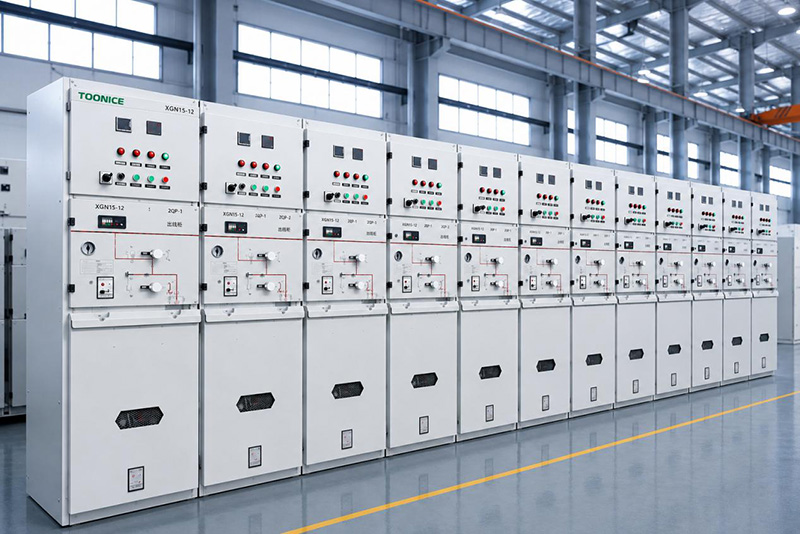
This design is widely used in commercial power distribution, small industrial plants and general electrical rooms where system complexity is lower and operating conditions are stable.
Structural Differences
Compartment Design
Metal Clad Switchgear divides internal space into multiple isolated compartments. The busbar section, breaker section and cable section are separated by metal barriers. This structure reduces the possibility of a fault in one section affecting other parts of the system.
Metal Enclosed Switchgear places components in a shared enclosure. Internal partitions exist but they are not designed to fully isolate functional units. The system is more compact but has less separation between components.
Circuit Breaker Arrangement
Metal Clad Switchgear uses withdrawable circuit breakers that can be removed from the operating position. This allows inspection or replacement without full system shutdown in many operating scenarios.
Metal Enclosed Switchgear uses fixed circuit breakers installed directly in the panel. Maintenance requires direct access to energized compartments which often leads to system shutdown during service.
Insulation and Physical Isolation
Metal Clad Switchgear relies on physical compartmentalization to reduce electrical interaction between components. This improves insulation coordination and reduces internal fault propagation.
Metal Enclosed Switchgear relies more on the enclosure housing and internal spacing. The insulation system is simpler and depends more on overall cabinet design rather than compartment separation.
Functional Differences
System Stability
Metal Clad Switchgear is designed so that a fault in one compartment does not easily affect the rest of the system. This supports more stable operation in networks where continuity is required.
Metal Enclosed Switchgear may allow a fault to influence a larger part of the system depending on configuration and protection settings. Its behavior is acceptable in non critical distribution environments.
Maintenance Method
Metal Clad Switchgear supports sectional maintenance. A single breaker or compartment can be isolated and serviced while the rest of the system continues operating. Metal Enclosed Switchgear usually requires feeder shutdown for maintenance. This increases downtime during inspection or repair work.
Fault Isolation Behavior
Metal Clad Switchgear contains faults within a defined compartment. This limits damage spread and simplifies post fault recovery. Metal Enclosed Switchgear has fewer internal barriers. Fault energy may propagate more widely before protective devices isolate the system.
System Expansion
Metal Clad Switchgear allows modular expansion by adding functional units into the existing lineup. This supports phased system development. Metal Enclosed Switchgear has limited modular flexibility. Expansion often requires redesign of the panel arrangement or replacement of sections.
Safety Differences
Internal Arc Performance
Metal Clad Switchgear is designed with compartmental structures that help control arc energy within a limited space. This reduces exposure to adjacent sections during fault events.
Metal Enclosed Switchgear relies on the enclosure to contain arc effects. Its ability to limit arc propagation depends more on cabinet strength and spacing design.
Operator Exposure
Metal Clad Switchgear reduces operator exposure during maintenance due to withdrawable components and isolated compartments. Metal Enclosed Switchgear requires more direct contact with internal components during service, which increases operational risk under maintenance conditions.
Standards and Compliance
Metal Clad Switchgear is commonly designed according to IEC and IEEE medium voltage standards with stricter compartmental requirements. Metal Enclosed Switchgear is used in applications where general compliance is sufficient and where system requirements are less demanding.
Application Differences
Metal Clad Switchgear is used in electrical systems that require stable power continuity and controlled fault behavior. Typical applications include industrial production facilities, data centers, power generation plants and utility distribution systems. These environments require predictable system response under fault conditions.
Metal Enclosed Switchgear is used in commercial buildings, small factories, residential distribution rooms and general electrical infrastructure. These applications typically operate under stable load conditions where outage impact is limited and system complexity is lower.
Cost and Maintenance Comparison
Initial Investment Cost
Metal Clad Switchgear requires higher manufacturing cost due to compartmental design, withdrawable mechanisms and more complex assembly processes. Metal Enclosed Switchgear has a simpler structure which reduces material usage and manufacturing complexity, leading to lower initial cost.
Maintenance Cost
Metal Clad Switchgear reduces downtime during maintenance since only part of the system needs to be isolated. Metal Enclosed Switchgear often requires full feeder shutdown which increases operational interruption during maintenance activities.
Life Cycle Cost
Metal Clad Switchgear is more suitable for long term operation in systems where continuity and fault isolation are prioritized. Metal Enclosed Switchgear is more suitable for projects where initial investment control is more relevant than long term operational flexibility.
Comparison Table
| Comparison Item | Metal Clad Switchgear | Metal Enclosed Switchgear |
| Internal structure | Fully compartmentalized design | Single enclosure structure |
| Isolation level | High separation between sections | Limited internal separation |
| Circuit breaker | Withdrawable type | Fixed type |
| Maintenance approach | Sectional maintenance possible | Feeder shutdown often required |
| Fault containment | Confined to compartment | Can spread beyond section |
| Expansion capability | Modular expansion supported | Limited flexibility |
| Cost level | Higher initial cost | Lower initial cost |
| Application scope | Utility and industrial systems | Commercial and general distribution |
Conclusion
Metal Clad Switchgear and Metal Enclosed Switchgear differ mainly in internal structure design and operational behavior during maintenance and fault conditions.

Toonice provides high quality Metal Clad Switchgear solutions and welcomes inquiries through our official website.
FAQs
Q1 Is Metal Clad Switchgear safer than Metal Enclosed Switchgear
Yes. The compartmental structure reduces exposure between functional sections during fault conditions and maintenance
Q2 Can Metal Enclosed Switchgear be used in industrial systems
It can be used in industrial environments where load conditions are stable and system interruption is acceptable
Q3 Why is Metal Clad Switchgear more expensive
The cost comes from compartmental construction, withdrawable breaker design and higher material usage
Q4 Which system is easier to maintain
Metal Clad Switchgear allows partial isolation which reduces maintenance impact on the full system
Q5 Are both types interchangeable in design projects
They are not directly interchangeable because they serve different system design requirements

--- END ---

MV & LV Equipment Manufacturer · Wenzhou, China
COMPANY
PRODUCTS
INDUSTRIES