- Phone / WhatsApp:+86 157 0677 9792
- sales@toonice.com
-
English
What Are the Differences Between AC and DC in Power Transmission Technology?
May 26,2026
Alternating current (AC) and direct current (DC) are two commonly used forms of electrical energy in power transmission systems. AC is suitable for large power grids and regional distribution, while DC is often used in long-distance, high-capacity, and special-purpose transmission projects.
AC systems have advantages in cost and scalability, especially for large power grids. DC is best suited for low-loss, high-voltage point-to-point connections. The conversion between AC and DC is both complex and expensive.
Therefore, optimizing power systems requires a clear understanding of the applications and limitations of AC and DC.
This article will explain the differences between AC and DC in terms of transmission technology, power loss, cost, and application scenarios.
Key Takeaways
- AC transmission is widely used in conventional power grids because voltage conversion is simple and infrastructure is mature.
- DC transmission is more efficient for long distance and high capacity power transfer because line losses are lower.
- AC systems are easier and less expensive to build for regional electricity distribution projects.
- DC systems are better suited for submarine cables, renewable energy delivery, and cross regional power transmission.
- Modern power networks usually combine both AC and DC technologies to improve efficiency and grid stability.
What Are Alternating Current and Direct Current?
Alternating current refers to electric current whose direction and magnitude change periodically. It is commonly used in household electricity, industrial facilities, and urban power grids.
One of the main characteristics of AC is that voltage can be adjusted easily through transformers, which is why it has been widely used in power transmission systems for many years.
Direct current refers to electric current whose direction remains constant. It is commonly found in batteries, solar power systems, electronic devices, and high voltage DC transmission systems.
DC transmission offers higher efficiency in long distance and submarine cable transmission projects, which makes it suitable for specific high capacity transmission scenarios.

Technical Features of AC Transmission
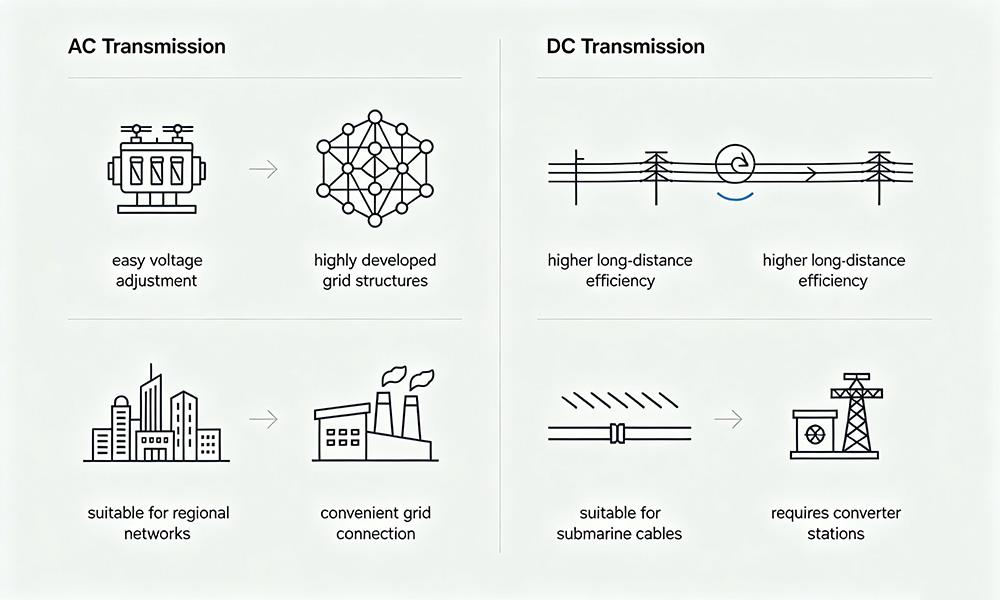
- Voltage can be adjusted easily because AC systems can use transformers for rapid voltage increase and reduction, which allows them to meet different transmission and distribution requirements.
- Grid structures are highly developed because AC transmission technology has been used for a long time, while equipment standards and maintenance systems are well established.
- AC transmission is suitable for regional power networks, including cities, factories, and residential areas where conventional power supply systems are widely required.
- Grid connection is relatively convenient because most power plants and electrical devices are designed to operate with AC systems.
- Long distance transmission may experience reactive power loss because transmission lines become less stable as distance increases.
Technical Features of DC Transmission
- Long distance transmission efficiency is higher because DC systems do not experience reactive power issues that commonly occur in AC transmission.
- Line losses are lower in high capacity and long distance projects, which gives DC transmission an advantage in certain scenarios.
- DC transmission is suitable for submarine cables because it is not affected by cable capacitive current.
- Converter stations are required because DC systems need conversion equipment that changes AC into DC and converts it back again.
- Initial construction costs are relatively high because converter stations involve complex equipment and advanced control systems, although long distance projects often achieve better overall economic performance.
Differences in Transmission Distance
AC transmission is more suitable for medium and short distance transmission projects, including urban grids, regional networks, and industrial power supply systems.
Since AC lines experience reactance, reactive power issues, and voltage stability challenges, system regulation becomes more difficult as transmission distance increases, while power loss also rises.
DC transmission is more suitable for long distance and high capacity transmission projects, especially for interregional and submarine transmission systems.
High voltage DC transmission reduces line loss and improves transmission stability, which is why it is often used to transfer electricity from western and northern energy bases to eastern load centers.
Differences in Voltage Conversion Methods
Voltage conversion in AC systems is relatively simple because transformers can increase or decrease voltage efficiently. Higher voltage at the generation stage reduces transmission loss, while voltage can later be reduced near users for practical applications.
As a result, AC transmission systems have mature structures and relatively convenient maintenance processes.
DC systems cannot use ordinary transformers directly for voltage conversion because they rely on converters and power electronic equipment instead. High voltage DC systems usually convert AC into DC before transmission begins, after which the electricity is converted back into AC when it reaches the receiving end.
Comparison of Transmission Loss and Efficiency
AC transmission performs efficiently in medium and short distance applications because the technology is mature and widely applied in conventional transmission systems.
However, in long distance projects, AC lines generate reactive power loss, corona loss, and stability challenges, while compensation equipment is often required to maintain voltage and power stability.
DC transmission provides higher efficiency in long distance and high capacity applications because it does not experience frequency synchronization or reactive power issues.
Line losses are relatively lower, although converter stations at both ends still generate some energy loss. For this reason, DC transmission may not always be more economical for short distance projects.
Comparison of Equipment Cost and Construction Difficulty
AC transmission equipment is generally less expensive because transformers, circuit breakers, switching devices, and protection systems are already mature technologies.
Construction complexity is also lower, which makes AC transmission more economical for urban distribution systems, industrial parks, and regional networks.
DC transmission lines offer advantages in long distance projects, although converter stations require higher investment and more complex control systems.
As a result, DC transmission projects usually involve higher initial construction costs, while they are more suitable for long distance, high capacity, submarine, and asynchronous grid interconnection projects.
What Are the Application Scenarios for AC and DC Transmission?
AC and DC transmission each have suitable application ranges, so one cannot completely replace the other. In practical power systems, AC and DC transmission technologies are often used together.
AC Transmission
AC transmission is mainly used in urban power grids, residential electricity supply, industrial systems, and regional power distribution networks.
Since AC systems allow voltage adjustment easily, they can support high voltage transmission, medium voltage distribution, and low voltage electricity usage. Household sockets, factory equipment, and commercial buildings generally rely on AC electricity.
DC Transmission
DC transmission is commonly used in ultra long distance transmission, submarine cable systems, and renewable energy delivery projects.
Large hydropower stations, wind farms, and solar power bases are often located far from electricity demand centers, so high voltage DC transmission improves efficiency while reducing transmission loss. Submarine cable projects also rely heavily on DC transmission systems.
Applications in Renewable Energy Systems
DC technology is becoming increasingly common in renewable energy systems. Solar photovoltaic systems naturally generate DC electricity, while energy storage batteries also operate with DC systems.
As a result, DC technology is widely applied in photovoltaic stations, energy storage projects, electric vehicle charging systems, and DC microgrids. However, electricity still needs to be converted into AC before it can enter public power grids.
Applications in Grid Interconnection
DC transmission can connect asynchronous power grids in different regions, which reduces the influence of frequency synchronization issues. When two AC grids cannot be connected directly, DC systems can transfer power between them, while improving grid stability and dispatch flexibility.
| Comparison Aspect | AC Transmission | DC Transmission |
| Current Direction | Changes direction periodically | Flows in one constant direction |
| Typical Frequency | Usually 50Hz or 60Hz | No frequency |
| Voltage Conversion | Easily transformed with transformers | Requires converters and power electronics |
| Transmission Distance | Better for short and medium distances | Better for long distance transmission |
| Power Loss | Higher reactive power loss over long distances | Lower line loss in long distance projects |
| Transmission Efficiency | Efficient in conventional regional grids | Highly efficient in ultra long distance systems |
| Equipment Complexity | Simpler and more mature systems | More complex converter stations |
| Initial Construction Cost | Lower upfront cost | Higher upfront investment |
| Maintenance Difficulty | Easier maintenance due to mature technology | More specialized maintenance required |
| Grid Compatibility | Easy integration with existing AC grids | Requires conversion equipment for integration |
| Stability Over Long Distance | Stability decreases as distance increases | More stable for large scale long distance transfer |
| Reactive Power Issue | Reactive power compensation required | No reactive power issue |
| Submarine Cable Use | Limited by capacitive effects | Highly suitable for submarine cables |
| Space Requirement | Usually requires three conductors | Often requires fewer conductors |
| Environmental Impact | Larger transmission corridors may be needed | Narrower corridors in some projects |
| Common Applications | Urban grids, residential supply, factories | Cross region grids, offshore transmission, renewable energy |
| Renewable Energy Integration | Requires conversion from DC sources | Naturally compatible with solar and battery systems |
| Typical Infrastructure | Transformers, substations, AC lines | Converter stations, HVDC lines |
| Technology Maturity | Very mature and widely used | Rapidly developing with modern power electronics |
| Best Use Scenario | Conventional regional power distribution | High capacity and ultra long distance transmission |
Conclusion: Which One Is Better?
Neither AC nor DC transmission can be considered universally better because the choice depends on the application scenario. AC transmission is suitable for conventional power supply systems and regional grids because costs are lower and the technology is mature.
DC transmission is more suitable for long distance, high capacity, and submarine projects because efficiency and stability are higher. Modern power systems usually combine both AC and DC technologies.

Toonice has a wide range of substations available for sale. Please feel free to consult our homepage for more information if you have any requirements.
FAQs
Q Is household electricity AC or DC?
Household electricity usually uses AC power, while common voltages are 220V or 110V depending on the country or region.
Q Why is high voltage DC often used for long distance transmission?
High voltage DC transmission offers advantages in line loss reduction, transmission stability, and high capacity power delivery.
Q Can AC be converted into DC?
Yes. Rectifiers can convert AC into DC.
Q Can DC be converted into AC?
Yes. Inverters can convert DC into AC.
Q Will AC transmission be replaced by DC transmission?
No. Since the two technologies serve different application scenarios, future power systems are more likely to combine both AC and DC transmission technologies.

--- END ---

MV & LV Equipment Manufacturer · Wenzhou, China
COMPANY
PRODUCTS
INDUSTRIES