- Phone / WhatsApp:+86 157 0677 9792
- sales@toonice.com
-
English

What Is A Load Break Switch? Types, and Applications
Feb 22,2026
Load switches are key switching devices in medium-voltage power distribution systems, used to safely connect or disconnect circuits under normal load current. Although they do not have the ability to interrupt short-circuit currents, they have become an indispensable component of substations and distribution networks in scenarios such as ring network power supply, transformer switching, and line segmentation, due to their advantages of simple structure, reliable operation, and optimized cost.
What Is a Load Switch?
According to the IEC 62271-103 standard, a load switch is defined as:
“A mechanical switching device is capable of connecting, carrying, and disconnecting current (including specified overload current) under normal circuit conditions at rated voltage, but cannot disconnect short-circuit current.”
Its core functions include:
- Operating under load: Can be closed/opened at rated current
- Visible isolation point: Provides a physical isolation point that complies with safety regulations
- In conjunction with fuses: Achieves full-range protection for transformers or cables by connecting a high-voltage current-limiting fuse in series.
Working Principle of Load Switch
Why is arc suppression necessary?
Arc suppression is necessary because when a switch’s contacts open while current is still flowing, the rapidly increasing electric field across the tiny gap can break down the air (or insulating medium) and create an arc,a high-temperature plasma that can reach thousands of degrees Celsius.
If the arc isn’t extinguished quickly, it can lead to:
- Contact erosion and overheating, damaging the switchgear
- Phase-to-phase faults or ground faults
- Serious safety hazards for operators
That’s why effective arc quenching is a core requirement in the design of load switches and switching devices.
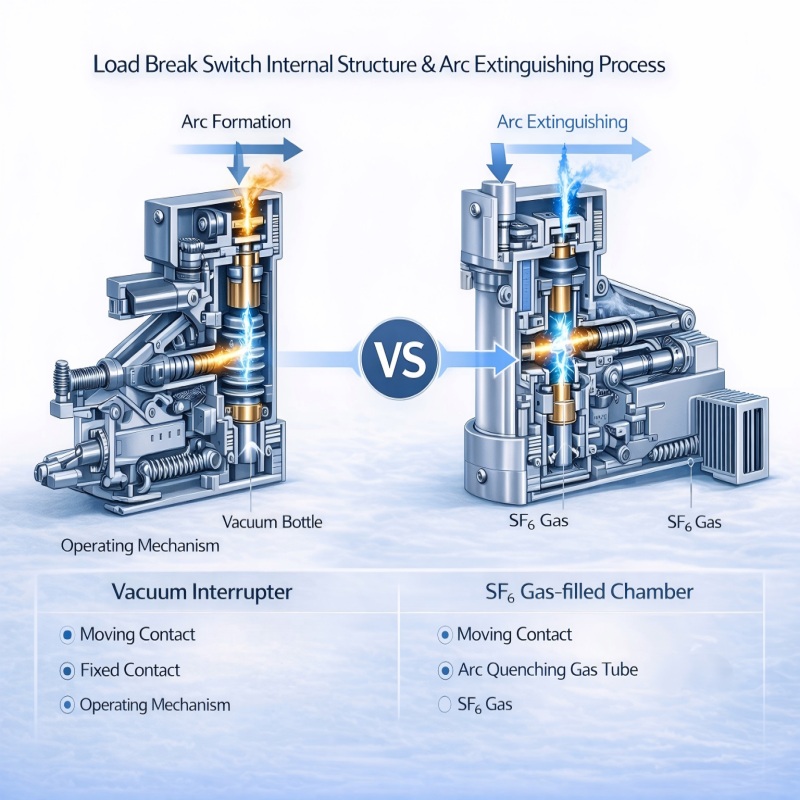
Comparison of mainstream arc extinguishing technologies
| Arc-Quenching Method | Operating Principle (American English) | Typical Applications |
| Gas-Generating | When the contacts separate, they ablate insulating material (such as acrylic or organic composites), producing high-pressure gas that blows and stretches the arc until it is extinguished. | Outdoor pole-mounted load break switches (LBS), typically 10–24 kV |
| Vacuum | Current is interrupted inside a vacuum interrupter; the arc consists of metal vapor, which diffuses and de-ionizes rapidly once the current crosses zero. | Indoor ring main units (RMUs) and compact switchgear |
| SF₆ Gas Insulated | SF₆ gas, with very high electron affinity, captures free electrons to quench the arc quickly while also providing excellent insulation. | High-reliability GIS/RMUs, typically 36 kV and above |

Main Types of Load Switches
Classification by installation environment and structure
| Type | Key Features (American English) | Typical Application Scenarios |
| Outdoor Pole-Mounted LBS | Gas-generating arc quenching, manual operation, and IP54-rated enclosure for outdoor environments. | Rural distribution networks, overhead line taps and feeders |
| Indoor RMU with Integrated LBS | Vacuum or SF₆ arc quenching, available in manual or motorized operation, compact and fully enclosed. | Urban distribution networks, commercial buildings |
| Metal-Clad Switchgear | Metal-enclosed, modular construction with comprehensive interlocking for high safety and reliability. | Industrial plants, data centers |
Key technical parameters
| Parameter | Typical Values | Standard Reference | Notes (American English) |
| Rated Voltage | 12 kV / 24 kV / 36 kV | IEC 62271-103 | Must match the system’s maximum operating voltage. |
| Rated Current | 400 A / 630 A / 1250 A | — | Drives conductor sizing and allowable temperature rise. |
| Short-Time Withstand Current | 20 kA / 3 s | IEC 62271-1 | Verifies thermal stability under fault conditions (not an interrupting/breaking rating). |
| Mechanical Endurance | ≥ 1,000 ops (gas-generating) / ≥ 10,000 ops (vacuum) | — | Impacts maintenance intervals and spares strategy. |
| Ingress Protection (IP) Rating | IP4X (indoor) / IP54 (outdoor) | IEC 60529 | Defines dust and water protection requirements for the enclosure. |
Typical Engineering Applications
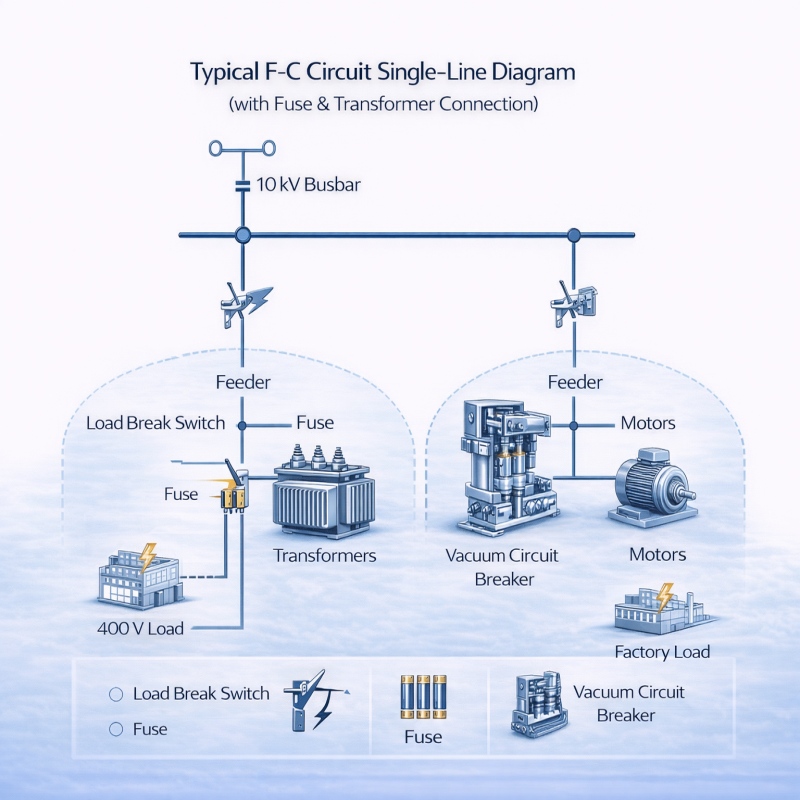
Transformer Protection (“F-C”Scheme)
- Configuration: A load-break switch (LBS) paired with medium-voltage current-limiting fuses (e.g., XRNT1-type)
- Why it’s used: The fuse clears short-circuits extremely fast (often under 10 ms), while the LBS provides isolation and normal switching/operating capability
- Best fit: Commonly applied for dry-type or oil-filled transformers up to 1250 kVA. For larger transformer ratings, a circuit breaker is generally recommended instead
Ring Main Unit
- LBS is used to switch power paths, achieving N-1 power supply reliability
- In conjunction with FTU (Fault Terminal Unit), it supports fault location and self-healing
Distributed energy access
- LBS is commonly used as a local isolation and operation point for photovoltaic/energy storage grid connection
- The effect of reverse current on arc extinguishing performance needs to be verified.
Conclusion
While a load-break switch is not an all-purpose switching device, within its intended operating range it delivers excellent value, high reliability, and simple operation, making it a true workhorse of modern power distribution systems.
For engineers and EPC teams, the key is to clearly define its performance boundaries: Avoid overdesign, and never exceed its limits.
As smart distribution grids and next-generation power systems continue to evolve, load-break switches are being increasingly integrated with sensors and communication modules, enabling intelligent operation and condition awareness.
A solid understanding of their operating principles and engineering applications is essential to building safe, efficient, and cost-effective distribution networks.
FAQ
-
What is the fundamental difference between a load-break switch (LBS) and a circuit breaker (CB)?
They are not interchangeable. The core difference is short-circuit interrupting capability.
Load-Break Switch (LBS):
- Designed to switch rated load current and limited overload current.
- Cannot interrupt short-circuit current.
Circuit Breaker (CB):
- Designed to safely interrupt the full range of fault currents, with built-in protective trip units.
- Using an LBS in place of a CB can result in failure to clear a short circuit, leading to equipment explosion, fire, or system collapse.
- In EPC design, applications must strictly comply with IEC 62271-103.
-
Why are load-break switches commonly combined with fuses?
- Because fuses compensate for the LBS’s lack of short-circuit protection.
- Current-limiting fuses clear short-circuit faults within milliseconds.
- The LBS handles normal switching and provides visible isolation.
- Together, they form a cost-effective, fully protected solution.
- This fused switch scheme is widely used for distribution transformers up to 1250 kVA.
-
Can a load-break switch interrupt transformer no-load or cable capacitive current?
Yes, but only within defined limits.
- Unloaded transformers and long cables generate capacitive charging current.
- Modern vacuum or SF₆LBSs are designed to interrupt small capacitive currents and must pass T10/T30 tests per IEC 62271-103.
- If capacitive current is excessive, there is a risk of arc restrike.
In such cases, transient simulation and verification are recommended.
-
How can you quickly tell a load-break switch from a disconnector?
You can identify them using three simple checks:
Nameplate marking
- LBS: marked “Load Break Switch” and shows a rated breaking current.
- Disconnector: marked “Disconnector” only.
Internal structure
- LBS: equipped with an arc-quenching system.
- Disconnector: no arc-quenching device.
Operating rules
- LBS: can be operated under load.
- Disconnector: must only be operated with no current, typically enforced by interlocks.
-
What special protections are required for outdoor pole-mounted LBSs?
Outdoor LBSs are exposed to lightning, condensation, pollution, and animal intrusion. EPC projects should ensure:
Surge protection
Metal-oxide surge arresters (MOA) on each phase; ground resistance ≤ 10 Ω.
Anti-condensation measures
Breathers or heaters; silver-plated contacts to prevent oxidation.
Safe operating distance
Operating rod length meeting clearance requirements.
Physical protection
Bird guards, anti-climbing spikes, and covers to prevent animal-caused faults.
-
How do load-break switches support remote control and monitoring in smart grids?
Modern LBSs are increasingly digitized and grid-connected, featuring:
- Motorized operating mechanisms for SCADA remote open/close control.
- Position sensors providing real-time status.
- Current and temperature monitoring via CTs or fiber-optic sensors for overload warnings.
Communication protocols
Modbus RTU/TCP and, in advanced RMUs, IEC 61850.
These capabilities enable condition-based maintenance, faster fault isolation, and improved grid reliability.

--- END ---

MV & LV Equipment Manufacturer · Wenzhou, China
COMPANY
PRODUCTS
INDUSTRIES