- Phone / WhatsApp:+86 157 0677 9792
- sales@toonice.com
-
English


Why Modern Infrastructure Needs Transformers?
Feb 01,2026
For over a century, power transformers have been a standard component of electricity distribution in homes, businesses, and industry. Transmission lines typically carry extremely high voltages, while everyday electrical equipment requires only about 110–250 volts.
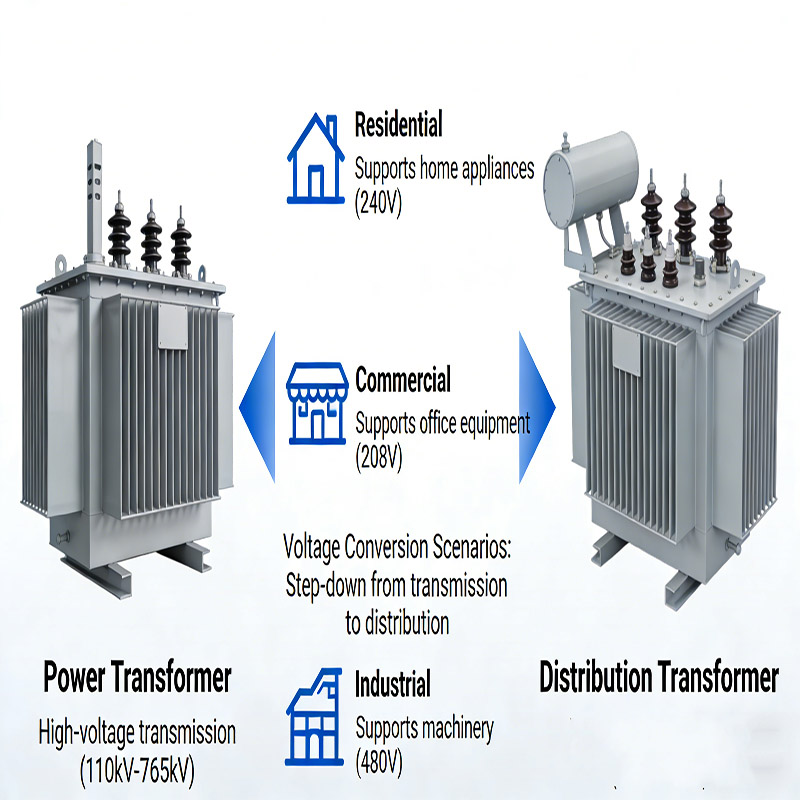
Transformers utilize the principle of electromagnetic induction to increase voltage for efficient long-distance transmission and then decrease it to a safer, more suitable level for lighting, home appliances, factories, data centers, and sports stadiums.
Let’s take a closer look at how it works!
What is a transformer?
A transformer is an electrical device that operates on the principles of electromagnetic induction and mutual inductance. It can convert input voltage into different levels of output voltage without changing the frequency of alternating current. By adjusting the turns ratio of the primary and secondary windings, a transformer can raise or lower the voltage to meet different power demands.

The primary function of a transformer is to support efficient transmission and safe distribution of electrical energy. Through its step-up and step-down functions, electricity can be transmitted over long distances with reduced losses and supplied to homes, businesses, and industrial systems at suitable voltage levels.
What is the working principle of a transformer ?
The working principle of a transformer is based on electromagnetic induction and mutual inductance. A transformer mainly consists of a magnetic core, a primary winding, and a secondary winding. When an alternating current (AC) power source is connected to the primary winding, current flows through the winding and generates a time-varying magnetic flux in the magnetic core. The core provides a low magnetic resistance path, allowing the magnetic flux to be efficiently transferred between the windings.
According to Faraday’s law of electromagnetic induction, changes in magnetic flux induce an electromotive force in the secondary winding, thereby generating voltage. The induced voltage is proportional to the turns ratio of the primary and secondary windings. By adjusting this ratio, voltage can be increased or decreased while the frequency remains constant, enabling effective and reliable power transmission and distribution.
What makes a transformer?
Magnetic core (Flux path & loss reduction)
The magnetic core provides a low magnetic resistance path for the magnetic flux generated by the windings. By guiding and concentrating the alternating magnetic field, it improves magnetic coupling between the primary and secondary windings. Laminated core construction helps reduce eddy current losses and limits heat generation, supporting stable operation and better efficiency.
Windings (Power transfer & voltage ratio)
Windings are made of copper or aluminum conductors and are responsible for transferring electrical energy into and out of the transformer. The primary winding receives electrical power, while the secondary winding delivers it to the load. The turns ratio between the windings determines whether the voltage is increased or decreased.
Insulation system (Electrical isolation & safety
The insulation system separates conductors and components operating at different electrical potentials. It prevents electrical breakdown, short circuits, and leakage currents while maintaining safe clearances during operation.
Oil tank (Enclosure & mechanical protection)
The oil tank houses the magnetic core and windings and protects them from external environmental influences. It provides mechanical strength, seals internal components from moisture and contaminants, and allows space for oil circulation.
Transformer oil (Insulation & heat transfer medium)
Transformer oil functions as both an insulating medium and a cooling agent. It helps remove heat from the core and windings and transfers it to the tank walls and cooling system.
Cooling system (Temperature control & stability)
The cooling system removes heat generated during transformer operation through oil or air circulation. Effective cooling keeps operating temperatures within acceptable limits and supports insulation performance.
Tap changer (Voltage regulation & fine adjustment)
The tap changer adjusts the effective number of turns in the winding to regulate output voltage. This allows the transformer to adapt to load changes and supply voltage variations.
Bushing (External connection & insulation)
Bushings provide a safe path for conductors to pass through the transformer tank while maintaining electrical insulation from the grounded enclosure and external environment.
Protection and monitoring devices
Protection and monitoring devices track operating conditions such as temperature, pressure, and internal status. When abnormal conditions are detected, alarms or shutdown actions help prevent further damage.
Types of power transformers
Step-up transformer
Increases voltage and is mainly used at the output end of power plants to support long-distance transmission. Higher voltage reduces current for the same power level, which helps lower line losses during transmission.
Step-down transformer
Reduces high voltage and is commonly used in substations and end-user systems. It converts transmission or distribution voltage into safer levels suitable for industrial equipment, commercial facilities, and residential use.
Distribution transformer
Installed near consumers to convert medium or high voltage into low voltage for daily use. It is widely used in urban and rural distribution networks and is designed for continuous operation with stable output.
Oil-immersed transformer
Uses transformer oil for insulation and cooling, offering large capacity and effective heat dissipation. It is commonly applied in outdoor substations and high-power installations, with the oil helping remove heat and protect internal insulation.
dry-type transformer
Uses air or solid insulation, does not require transformer oil, and offers high safety with low maintenance. It is often used indoors, such as in buildings, hospitals, and commercial centers, where fire safety and clean operation are preferred.
What affects the efficiency of a transformer?
Core loss (iron loss)
Caused by hysteresis and eddy currents in the magnetic core under an alternating magnetic field. This loss exists whenever the transformer is energized, even at no load, and is influenced by core material, flux density, and operating frequency.
Copper loss
Results from electrical resistance in the primary and secondary windings. As load current increases, more energy is converted into heat. Copper loss depends on conductor material, cross-sectional area, winding length, and operating temperature.
Load level
Transformer efficiency varies with load. Efficiency is usually higher when operating close to the rated load, while very light or heavy loading leads to higher relative losses.
Core structure and design
Core shape, lamination quality, and magnetic path design affect flux distribution and leakage, influencing overall loss levels and energy transfer quality.
Winding arrangement and insulation
Proper winding layout and insulation design improve magnetic coupling, reduce leakage flux and resistive losses, and support stable transformer operation under practical conditions.
Where can power transformers be used?
Power transmission and distribution networks
Power transformers are widely used across transmission lines and distribution systems to manage voltage levels for different stages of the grid.
Step-down transformers
Reduce high voltage to levels suitable for homes, businesses, and industrial equipment.
Step-up transformers (voltage boosting for delivery and equipment)
Increase voltage for supply needs and are used with equipment such as electric motors, X-ray machines, and microwave ovens.
Measurement and protection systems
Current transformers (CTs) and voltage transformers (VTs) measure high current and high voltage while providing electrical isolation for safety and monitoring.
Single-phase transformers
Commonly used in household inverters and residential electronic equipment.
Three-phase transformers
Widely applied in power plants, production systems, and high-power industrial loads, helping promote reliable operation of modern power systems.
What precautions should be taken when using a transformer?
The input voltage of the transformer should match its rated voltage to avoid long-term overvoltage or undervoltage operation. Load capacity should be properly controlled to prevent overheating, insulation degradation, and reduced service life.
Transformers should be installed in dry, clean, and well-ventilated environments, avoiding high temperatures, humidity, and dust accumulation. Effective heat dissipation helps maintain stable operation.
The safe operation and routine maintenance of transformers also require attention. Proper grounding, regular inspection of insulation and temperature, and timely handling of abnormal conditions help support safe and long-term operation.
Conclusion
Transformers help promote efficient power transmission and stable electricity distribution. Although different applications require different transformer designs, power transformers and distribution transformers continue to support reliable energy delivery and rational voltage conversion in residential, commercial, and industrial environments.

Please visit our product page to find the product best suited for your application.
FAQs
Q: Why do transformers make a humming sound?
The sound is mainly caused by magnetostriction of the magnetic core. Loose components and electromagnetic forces under load may increase the noise.
Q: What happens when a transformer fails?
Possible effects include overheating, abnormal voltage, protection trips, and in severe cases, insulation damage, winding burnout, or power outages.
Q: Does a transformer consume electricity even when there is no load?
Yes. Iron losses, including hysteresis and eddy current losses, occur even under no-load conditions.
Q: What is the lifespan of a transformer?
The typical service life is about 20–30 years, though overheating, moisture, and insulation aging can shorten it.

--- END ---

MV & LV Equipment Manufacturer · Wenzhou, China
COMPANY
PRODUCTS
INDUSTRIES