- Phone / WhatsApp:+86 157 0677 9792
- sales@toonice.com
-
English
What is Gas Insulated Switchgear (GIS) and How Does It Work?
Nov 30,2025
Gas insulated switchgear (GIS) is a core component of modern high-voltage and ultra-high-voltage power transmission and distribution systems. By sealing all live components in a high-pressure insulating gas (such as SF₆ or environmentally friendly alternatives), it achieves extreme compactness, high reliability, and maintenance-free operation. Typical application voltages range from 72.5 kV to 220 kV+, and it is widely deployed in urban substations, underground stations, offshore platforms, hydropower stations, and critical infrastructure with stringent space and environmental requirements.
For power system engineers, EPC contractors, and project decision-makers, a deep understanding of the technical boundaries, safety specifications, and lifecycle management of GIS is crucial for ensuring grid security, controlling project risks, and responding to global environmental trends.
What Is A Gas insulated Switchgear (GIS)?
According to IEC 62271-203, a GIS (Gas Insulated Switchgear) is defined as:
“A metal-enclosed switchgear in which all live parts of the main circuit are housed within a grounded metal enclosure, using compressed insulating gas as the primary insulating medium.”
Its core components are typically integrated into the same or modular gas chamber, including:
- Circuit breaker (CB): interrupts short-circuit current
- Disconnecting switch (DS) and grounding switch (ES): provide electrical isolation and safety grounding
- Current transformer (CT) and voltage transformer (VT): used for measurement and protection
- Surge arrester (LA) and cable termination
Key features:
- Fully enclosed, fully insulated, and fully shielded;
- No external exposed live parts, unaffected by humidity, salt spray, dust, or snow;
- Footprint is only that of an AIS (Air Insulated Switchgear).
Working Principle and Insulation Mechanism of GIS
Why can gases achieve highly efficient insulation?
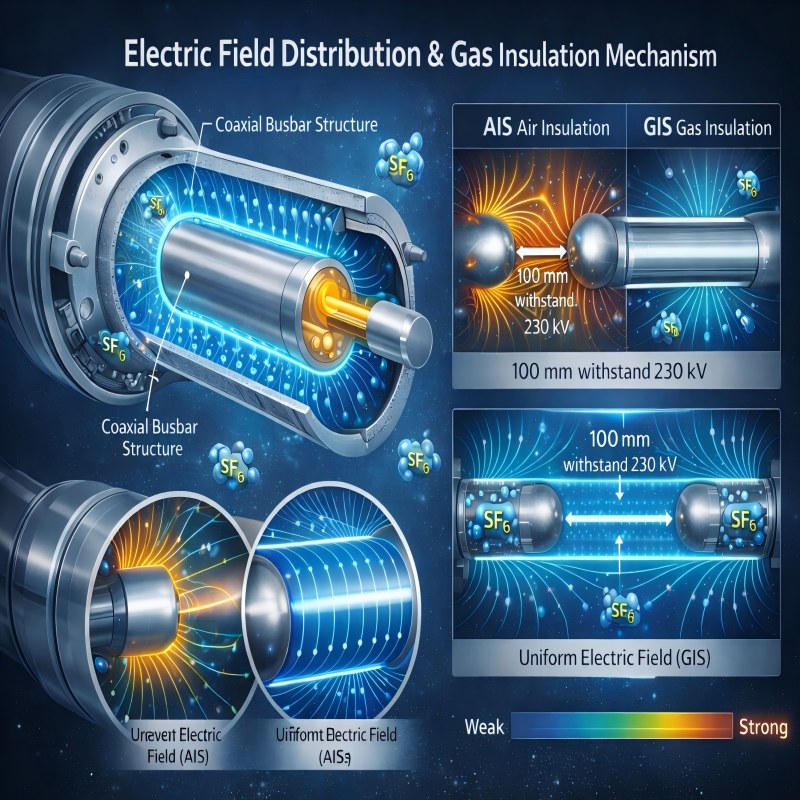
Under standard atmospheric pressure, the dielectric strength of air is approximately 3 kV/mm. High-purity SF₆gas, at pressures of 0.4–0.6 MPa, can achieve a dielectric strength of 8–9 kV/mm, approximately 2.5–3 times that of air. Its superior insulation performance stems from:
- Strong electronegativity: SF₆molecules readily capture free electrons, forming heavy negative ions and inhibiting electron avalanche propagation;
- High thermal conductivity: Effectively cools arc channels and accelerates dielectric recovery.
When a system voltage is applied to the GIS conductor, the high-density SF₆gas molecules form a stable insulating barrier, preventing partial discharge and breakdown.
Environmental challenges and alternative trends in SF₆
SF₆is a potent greenhouse gas with a global warming potential (GWP) of 23,500. The EU F-gas regulation clearly states:
- From 2026: SF₆ will be prohibited in new installations of ≤24 kV
- From 2030: This will be extended to installations of ≤36 kV
The industry is accelerating its shift to environmentally friendly alternative gases, such as:
- Dry air (N₂/O₂ mixture): GWP=0, suitable for medium pressure
- g³ (Green Gas for Grid): 3M Novec™ 4710 + CO₂/O₂, GWP<1
- Clean Air (80% N₂ + 20% O₂): CHINT, Siemens, and others have launched commercial products

Main Types of GIS
Classification by structure and voltage level
| Type | Full Name | Key Characteristics | Typical Applications |
| Conventional GIS | Conventional Gas Insulated Switchgear | All components housed in a common enclosure; fewer gas compartments | Extra-high-voltage substations (≥ 363 kV) |
| Hybrid GIS (H-GIS) | Hybrid Gas Insulated Switchgear | Circuit breakers and current transformers enclosed in SF₆ gas; busbars exposed | Space-constrained 220 kV retrofit substations |
| Compact GIS | Compact Gas Insulated Switchgear | Modular design with independent gas compartments per bay | Urban 110 kV distribution substations; industrial power users |
The Parameters
| Parameter | Requirement | Applicable Standard | Engineering Significance |
| Annual Leakage Rate | ≤ 0.5% per year | IEC 62271-203 | Affects environmental compliance and gas replenishment intervals |
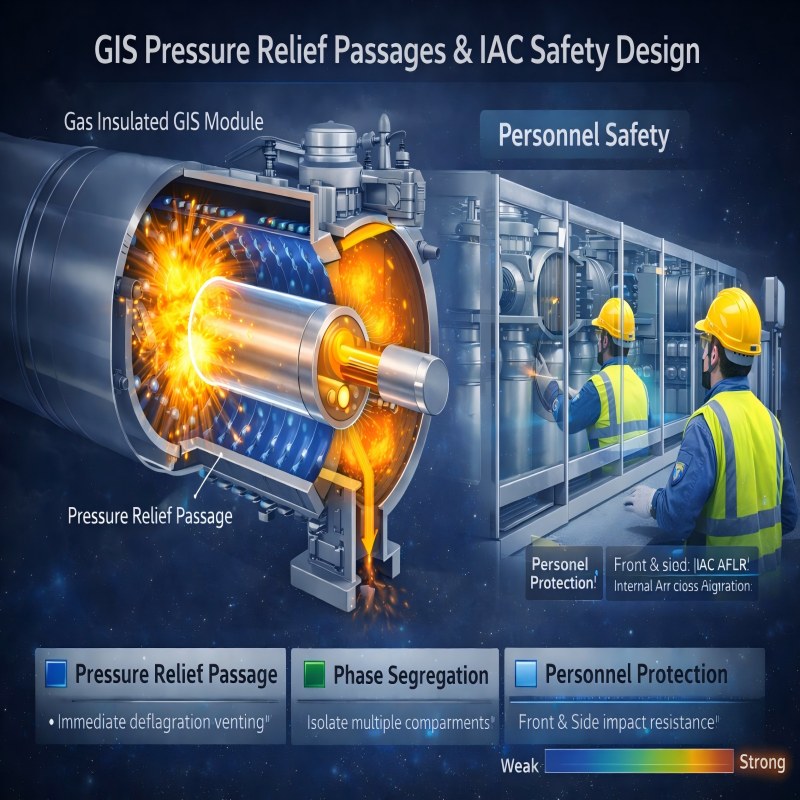
| IAC Rating | AFLR | IEC 62271-200 | Certification for internal arc fault safety |
| Partial Discharge Level | ≤ 5 pC at 1.2 × Um / √3 | IEC 60270 | Indicates manufacturing quality and insulation integrity |
| SF₆ Recovery Rate | ≥ 99% | IEC 62271-4 | Environmental compliance requirement during decommissioning |
Typical Engineering Application Scenarios
| Scenario | Key Challenges | Advantages of GIS Solutions |
| Urban Central Substations | High land costs; strict noise limits | Footprint reduced by up to 70%; operating noise < 65 dB |
| Underground / Tunnel Substations | Poor ventilation; high humidity | Fully sealed design, unaffected by ambient conditions |
| Offshore Wind Power Platforms | Salt spray corrosion; extremely limited space | High corrosion protection (C5-M); modular design for lifting and installation |
| High-Altitude Areas (> 3,000 m) | Low air density; high flashover risk with AIS | Gas insulation performance independent of altitude |
Case Study: After adopting GIS, a 220 kV underground substation in a first-tier city reduced its land area from 8,000 m² to 800 m², saving over 200 million yuan in land costs.
Conclusion
GIS represents the pinnacle of high-voltage switchgear evolution towards high density, high reliability, and green technology. However, facing increasingly stringent environmental regulations, SF₆-free GIS is becoming an irreversible trend. GIS is not just equipment, but a comprehensive solution encompassing space, safety, and sustainability.
Appendix: Commonly Used Standards
- IEC 62271-203: Gas-insulated metal-enclosed switchgear for rated voltages above 52 kV
- IEC 62271-4: Handling procedures for SF₆
- EU No 573/2024: F-gas Regulation (phasing down SF₆)
- GB/T 28537: Use and treatment of sulfur hexafluoride (SF₆) in high-voltage switchgear and control equipment
FAQ
-
Is GIS completely maintenance-free?
No. While GIS does not require routine cleaning and insulation checks, it still requires:
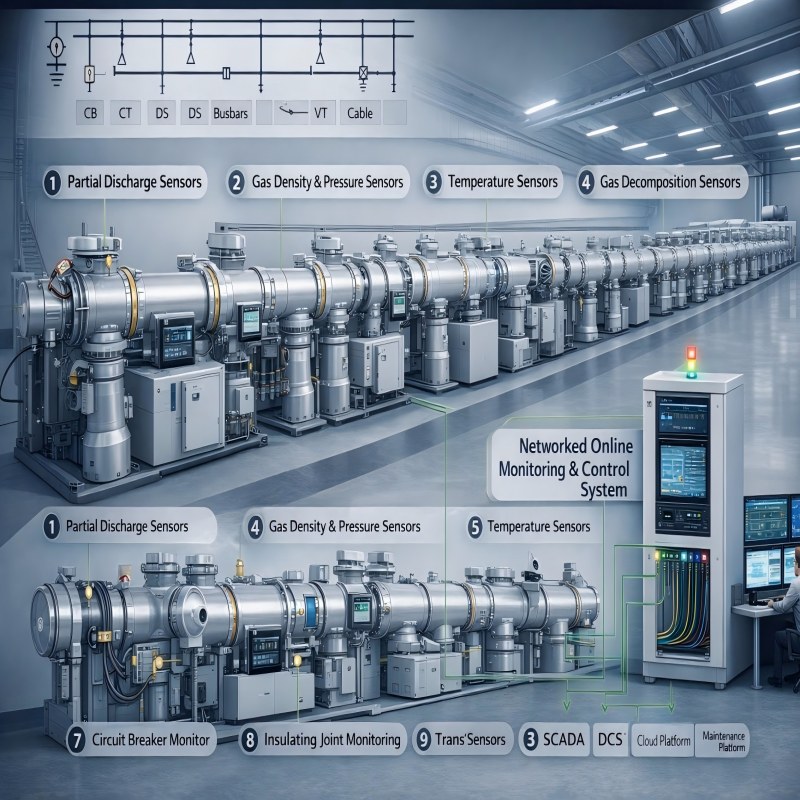
- Regular SF₆pressure/density monitoring (online monitoring recommended)
- Lubrication of mechanical operating mechanisms (every 5–10 years)
- Detection of trace moisture content (≤150 ppm, to prevent HF corrosion)
- Partial discharge detection (to identify potential defects)
-
How to detect SF₆ leakage in GIS?
Common methods include:
- Infrared imaging leak detector: visualizes gas clouds with high sensitivity
- TDLAS (Diverterless Transmission Laser Spectroscopy): online continuous monitoring with an accuracy of 1 ppmm
- Pressure-temperature compensated density relay: indirectly determines leaks (temperature effects must be excluded)
- Helium mass spectrometry leak detection (before leaving the factory): leak rate < 1×10⁻⁸ Pam³/s
3. Is the performance of SF₆-free GIS equivalent to that of SF₆GIS?
It is essentially equivalent in the medium-voltage range:
- Clean Air GIS: Equivalent insulation levels can be achieved at 145 kV and below through optimized electric field design (e.g., increased gaps, use of shielding rings).
- g³ GIS: Dielectric strength close to SF₆, already used in 420 kV systems (GE, Hitachi).
- Disadvantages: Slightly larger chamber volume (+10–20%), but still within a compact range.
-
How to release pressure when a GIS malfunctions internally?
- GIS is equipped with a rupture membrane and pressure relief channel
- When internal combustion generates high-pressure gas, the rupture membrane breaks under a set pressure (e.g., 0.8 MPa)
- The high-temperature gas is then discharged to a safe area (e.g., rooftop or outdoors) via a directional pressure relief pipe
- The design must meet IAC AFLR rating to protect operators
-
Can GIS be used in areas with high earthquake intensity?
Yes, but it requires special design:
- Flexible corrugated pipe connections are used to absorb displacement.
- Seismic calculations (response spectrum analysis) are performed on the support structure.
- Seismic-resistant flanges are used between air chambers.
- Numerous seismic fortification cases of seismic intensity 8 and above have been implemented in countries such as Japan and Chile.
- Standard references: IEEE 693, IEC 62271-207
-
How should SF₆be handled when dismantling old GIS systems?
A closed-loop recycling process must be followed:
- The gas is drawn into a storage tank using an SF₆recovery device
- After purification (filtration of moisture and decomposition products), its purity is tested
- Qualified gas: reused in new equipment
- Unqualified gas: sent to a qualified unit for high-temperature pyrolysis (>1200°C) to convert it into harmless substances
- Direct emission is strictly prohibited! Violations of F-gas regulations will result in hefty fines

--- END ---

MV & LV Equipment Manufacturer · Wenzhou, China
COMPANY
PRODUCTS
INDUSTRIES