- Phone / WhatsApp:+86 157 0677 9792
- sales@toonice.com
-
English

What is a Ring Main Unit?
Feb 15,2026
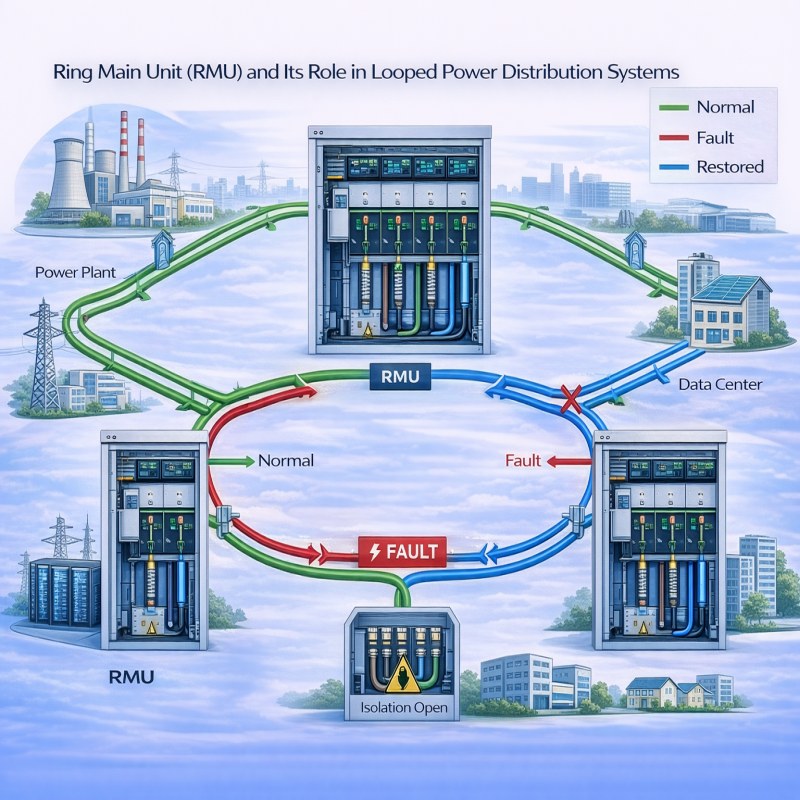
A ring main unit (RMU) is a core switching device in medium-voltage distribution networks, specifically designed for ring network power supply systems to achieve segmentation, protection, isolation, and switching of cable feeders. Its typical application voltage levels range from 12 kV to 35 kV, and it is widely deployed in urban distribution networks, industrial parks, commercial complexes, data centers, and new energy access points.
Important Definition: According to IEC 62271-200, an RMU is a metal-enclosed switchgear, typically containing two incoming units, used to form a distribution ring network operating in closed or open loop mode.
The Core Function of Ring Main Unit
The RMU performs three core functions in the power distribution system
Power supply continuity guarantee
- With a dual-power ring network structure, when a section of the line fails, the faulty section can be quickly isolated, and power can be restored to the non-faulty area from the other power source
- The switching time can be as short as 30–60 seconds, significantly better than traditional radial networks
Equipment protection and isolation
- Integrated load switches (LBS) or circuit breakers (CBs), in conjunction with high-voltage current-limiting fuses, provide full-range protection for transformers and cables
- Provides visible breaks and mechanical interlocks to meet operational safety regulations
Flexible expansion and intelligent access
- The modular design supports plug-and-play expansion
- A communication interface is reserved to support remote monitoring, fault location, and self-healing control
Types and Technical Architectures of RMUs
Classification by main switch type
| Type | Full Name | Key Features | Typical Applications |
| LBS + Fuse | Load Break Switch–Fuse Combination | Low cost; transformer protection up to 1250 kVA | Commercial buildings, residential complexes |
| Vacuum CB | Vacuum Circuit Breaker | Capable of interrupting short-circuit currents; suitable for frequent switching operations | Industrial plants, data centers, PV step-up substations |
Selection principles
- If the downstream is a single transformer with a capacity ≤1250 kVA, LBS+Fuse (economical and efficient) should be preferred
- If multiple outgoing lines, frequent switching, or high reliability requirements are needed, a vacuum circuit breaker type RMU must be selected

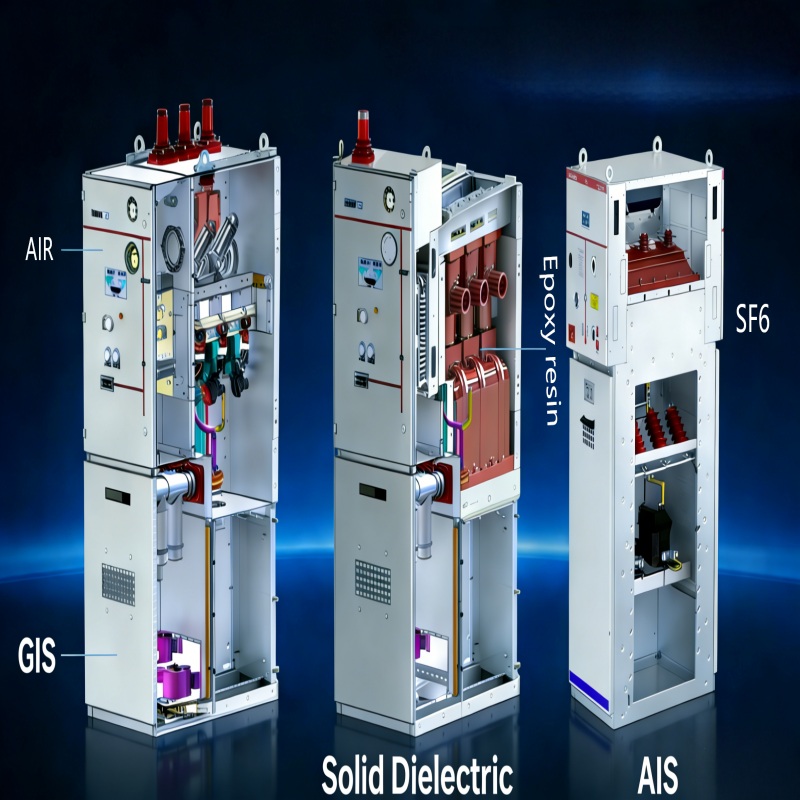
Classification by insulation method(IEC 62271-200)
| Type | Insulation Medium | Advantages | Limitations | |
| Air-Insulated (AIS) | Dry air | Low cost; easy to inspect and maintain | Large footprint; affected by environmental conditions such as humidity and pollution | |
| Gas-Insulated (GIS) | SF₆ or eco-friendly gases (e.g., Clean Air) | Extremely compact (up to 70% space savings); maintenance-free; IP67-rated enclosure | Higher upfront cost; SF₆ requires strict environmental management | |
| Solid-Insulated Switchgear (SIS) | Epoxy resin / silicone rubber | Gas-free and environmentally friendly; excellent resistance to condensation | Limited heat dissipation; mainly used in high-altitude areas with thin air |
Key Technical Parameters
Core performance parameters
| Parameter | Typical Values (12 kV Class) | Applicable Standard | Engineering Significance | |
| Rated Voltage | 12 kV / 24 kV | IEC 62271-200 | Must be ≥ the system’s maximum operating voltage (Um = 12/√3 × 1.1 ≈ 7.2 kV) | |
| Rated Current | 630 A / 1250 A | — | Determines cable sizing and permissible temperature rise | |
| Short-Circuit Interrupting Capacity | LBS: Not applicable / CB: 20–25 kA | — | Circuit breaker type must be verified against the system short-circuit level | |
| Internal Arc Classification (IAC) | AFLR | IEC 62271-200 Annex AA | Ensures personnel safety (test pressure ≥ 1.5 bar) | |
| Loss of Service Continuity (LSC) | LSC-2B | — | Allows maintenance on one compartment while keeping the remaining feeders energized |
Typical Engineering Application Scenarios
| Application Scenario | Key Challenges | RMU Solution |
| Urban Underground Substations | Severe space constraints; high humidity | SF₆ GIS RMU with IP67 protection; maintenance-free design |
| Industrial Parks | Multiple transformers; high reliability requirements | Vacuum circuit breaker–type RMU with automation terminal (FTU) |
| PV / Energy Storage Plants | Outdoor installation; frequent switching operations | Solid-insulated or SF₆ RMU with C3 anti-corrosion coating; remote control capability |
| Commercial Complexes | Aesthetic requirements; low noise levels | Compact AIS RMU, wall-integrated installation, operating noise below 55 dB |
Conclusion
Ring main units (RMUs) are the physical foundation for the transformation of modern power distribution networks from “passive response” to “active self-healing.” For engineers and EPC teams, selecting the appropriate switch type, insulation method (and level of intelligence) is key to achieving the optimal balance between cost, reliability, and sustainability.
Driven by new power systems and “dual-carbon” goals, RMUs are rapidly evolving towards SF₆-free, digital (state-aware), and modular (rapid deployment), becoming indispensable intelligent terminals for building resilient power distribution networks.
Appendix: Commonly Used Standards
IEC 62271-200: AC metal-enclosed switchgear for rated voltages above 1 kV and up to 52 kV
GB/T 11022: Common technical requirements for standards on high-voltage switchgear and controlgear
DL/T 593: Common technical requirements for standards on high-voltage switchgear and controlgear
FAQ
1. Can the load switch in the RMU interrupt the short-circuit current?
Absolutely not! Load switches (LBS) can only interrupt rated load current (e.g., 630 A) and small multiples of overload current. Short-circuit current (e.g., 20 kA) must be interrupted by a high-voltage current-limiting fuse connected in series. Using an LBS to interrupt a short circuit will result in equipment explosion.
2. Is a GIS RMU necessarily superior to an AIS RMU?
This is not the case,a comprehensive assessment is required:
| Dimension | AIS RMU | GIS RMU |
| Initial Cost | Low (approx. RMB 80,000–120,000 per unit) | High (approx. RMB 150,000–250,000 per unit) |
| Footprint | Large (about 1000 mm wide) | Compact (about 600 mm wide, ~40% space savings) |
| Maintenance | Easy to inspect; on-site maintenance possible | Factory return typically required; high dependence on supplier |
| Environmental Impact | No greenhouse gases involved | SF₆ requires strict management (GWP = 23,500) |
Recommendation: GIS is recommended for areas with limited space or high humidity, AIS is more economical for conventional industrial plants.
3. How to verify the “five protections” function of RMU?
Five protectionsrefers to:
- Prevent accidental opening/closing of switches
- Prevent opening/closing of disconnecting switches under load
- Prevent connecting grounding wires while the circuit is energized
- Prevent closing the circuit with the grounding wire connected
- Prevent accidental entry into energized compartments
Verification method
- Simulate each violation during the FAT (Factory Acceptance Test)
- Check whether the mechanical/electrical interlocks are forcibly blocked
- Require the supplier to provide a five-proof logic diagram and sign for confirmation
4. Can an RMU be used for generator output protection?
Not recommended. Generator short-circuit current decays slowly and has a high DC component, placing extremely high demands on the breaking capacity of switchgear. RMUs are typically designed for the distribution side (feeder protection), not the power supply side.
Recommendation: Use a dedicated generator circuit breaker at the generator outlet.
5. What communication protocols does a smart RMU need to support?
Mainstream protocols include:
- Modbus RTU/TCP: Used for SCADA data acquisition;
- IEC 61850 (GOOSE/MMS): Used for advanced applications in smart substations
- DNP3: Commonly used in the North American market
6. What are the environmentally friendly alternatives for SF₆RMU?
The industry is rapidly shifting towards SF₆-free RMUs:
- Dry air (N₂/O₂): CHINT and Siemens offer commercially available products
- Clean air (80% N₂ + 20% O₂): GWP=0, suitable for 12–24 kV
- g³ gas (3M Novec™): Dielectric strength close to SF₆, but at a higher cost
- The EU F-gas regulation will restrict the use of SF₆in new equipment from 2026

--- END ---

MV & LV Equipment Manufacturer · Wenzhou, China
COMPANY
PRODUCTS
INDUSTRIES