- Phone / WhatsApp:+86 157 0677 9792
- sales@toonice.com
-
English



Is It Safe to Live Near a Substation?
May 19,2026
A substation is a facility in the power system that is used for voltage conversion and power distribution, which helps supply stable electricity to cities, factories, and residential areas.
Many people who plan to buy a house worry about whether living near a substation may cause radiation exposure, safety concerns, or health risks. In fact, substations generate low frequency electromagnetic fields rather than nuclear radiation.
This article explains how substations work, the difference between electric fields and magnetic fields, whether substations are safe, and how to determine whether a nearby substation should be a concern.
What Is a Substation?
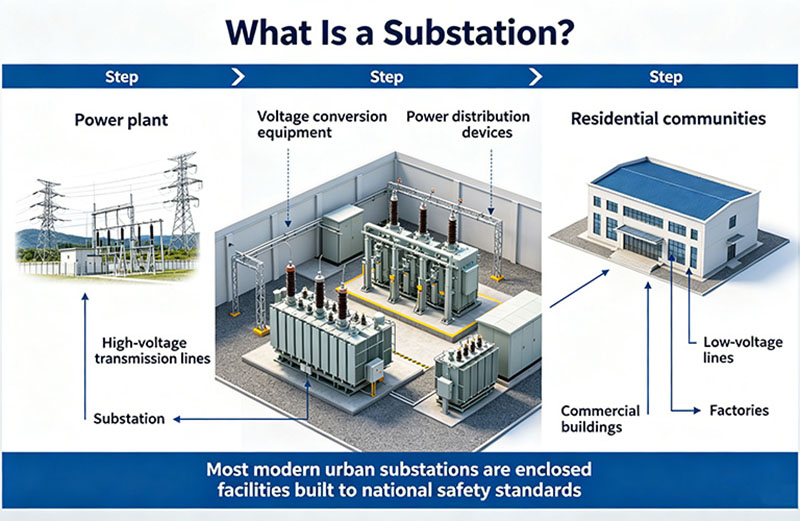
A substation is part of the electrical power system, which is used to convert voltage levels, distribute electricity, and maintain stable power transmission.
Electricity that is generated by power plants is transmitted through high voltage lines to different regions, after which substations reduce the voltage before the electricity is delivered to residential communities, commercial buildings, and factories.
Most modern substations in urban areas are designed as enclosed facilities that are built according to national safety standards.
What Are Electric Fields and Magnetic Fields?
Electric Field
An electric field is a type of energy field that is created by voltage whenever electrical equipment is energized. Even if no current is flowing, an electric field will still exist as long as voltage is present. Household appliances, electrical wires, and phone chargers all generate electric fields during operation.
The strength of an electric field decreases rapidly as the distance increases, while walls, trees, and other objects can also provide a certain level of shielding.
Magnetic Field
A magnetic field is a type of energy field that is generated when electric current flows through wires or electrical equipment. Substations, transmission lines, and household appliances all produce magnetic fields to some extent.
Unlike electric fields, magnetic fields are more difficult to block with ordinary building materials, although their strength also decreases significantly as the distance increases.
What Types of Electromagnetic Fields Do Substations Generate?
Power Frequency Electric Fields
Substations generate power frequency electric fields during operation, which are among the most common types of electromagnetic fields.
These electric fields mainly come from high voltage equipment and transmission lines, while their frequency is usually 50 Hz or 60 Hz, which belongs to the category of extremely low frequency electromagnetic fields.
In most cases, the field strength decreases significantly at locations farther away from the equipment, which means that the electric fields experienced in residential areas are generally below national safety limits.
Modern enclosed substations also use metal enclosures and isolation structures that help reduce the impact of electric fields on the surrounding environment.
Power Frequency Magnetic Fields
In addition to electric fields, substations also generate power frequency magnetic fields. Magnetic fields are produced by electric current, while transformers, cables, and transmission equipment all contribute to magnetic field generation.
In general, magnetic field strength depends on the equipment load, the amount of current, and the distance from the source.
For ordinary residents, the magnetic field exposure in daily life is usually far below the recommended safety limits. In fact, household appliances such as refrigerators, hair dryers, and induction cookers can also generate similar low frequency magnetic fields when they are used at close range.
Transient Electromagnetic Phenomena
Substations may also produce short term transient electromagnetic phenomena during equipment switching, lightning protection operations, or power grid fluctuations. These electromagnetic changes usually last for a very short period, while their impact on nearby residents is limited.
Modern substations are equipped with grounding systems and protective devices that help reduce electromagnetic fluctuations affecting equipment and the surrounding environment. Since these phenomena do not occur continuously, most residents are unlikely to notice obvious changes in daily life.
Is Exposure to Electromagnetic Fields Safe?
Most studies suggest that low frequency electromagnetic fields in normal environments do not cause confirmed harm to human health.
The World Health Organization and safety standards in many countries have established limits for electromagnetic field exposure, while substations that are legally constructed must comply with these standards before they begin operation.
For ordinary residents, electromagnetic field exposure usually remains within a safe range as long as a reasonable distance from the substation is maintained.
What Is the Radiation That People Worry About?
When people hear the word radiation, they often think about nuclear power plants or radioactive materials. However, substations do not produce nuclear radiation, since they generate low frequency electromagnetic fields instead.
Low frequency electromagnetic fields belong to non ionizing radiation, which is different from X rays and nuclear radiation.
Everyday devices such as mobile phones, WiFi routers, televisions, and household appliances also generate electromagnetic radiation, which means that the radiation associated with substations is more related to the electromagnetic environment than radioactive contamination.
Is It Dangerous to Enter a Substation?
Ordinary residents should not enter substations without permission because high voltage equipment, electrical lines, and complex power systems are located inside. Unauthorized entry may lead to electric shock, arc burns, or accidental contact with electrical equipment.
Formal substations are usually equipped with fences, warning signs, and safety management systems that are designed to prevent people from entering hazardous areas. For nearby residents, normal daily life is generally not affected as long as restricted areas are avoided.
How to Determine Whether a Substation Should Be a Concern?
Check the Type of Substation
The first step in evaluating whether a substation should be a concern is understanding its type and scale. In residential communities, the most common substations are 110 kV or 220 kV facilities, while ultra high voltage substations are usually located farther away from residential areas.
Most modern urban substations are designed as indoor or underground enclosed facilities, which helps reduce noise and electromagnetic field exposure. Compared with older open air substations, modern enclosed substations generally have less impact on the surrounding environment.
Consider the Distance From Residential Areas
Distance is one of the factors that affects electromagnetic field strength. In general, the farther a residential building is located from a substation, the lower the electric field and magnetic field exposure will be. National regulations also require safety distance planning and approval during substation construction.
For ordinary residents, the actual impact may be reduced further if roads, green belts, or other buildings are located between the residence and the substation, which means there is usually no need for excessive concern.
Check Whether It Meets National Standards
Substations that are legally constructed usually undergo environmental assessments and government approval procedures before construction begins. These procedures may include electromagnetic environment testing, noise monitoring, and safety evaluations.
Residents can review public environmental assessment reports or consult local authorities to understand the compliance status of a substation. If a substation has been approved according to national standards, its electromagnetic field exposure and environmental impact are generally controlled within acceptable limits.
Conclusion
Living near a substation does not automatically mean that there is a health risk. Most modern substations are built according to strict standards, while the low frequency electromagnetic fields they generate usually remain below safety limits.
Instead of worrying excessively, it is more practical to understand the substation type, the distance from residential areas, and whether the facility complies with national regulations.

FAQs
Q: Can houses near substations be purchased?
Yes. If the substation complies with national construction standards and maintains a reasonable distance from residential areas, purchasing a nearby house is generally considered acceptable.
Q: Is radiation from substations the same as nuclear radiation?
No. Substations generate low frequency electromagnetic fields rather than nuclear radiation.
Q: Is it more dangerous to live closer to a substation?
Electromagnetic field strength decreases as the distance increases, while substations that meet safety standards are usually controlled within safe exposure limits.
Q: Can substations affect sleep quality?
Some older substations may produce low frequency noise, although modern enclosed substations usually have less impact.
Q: How can people check whether a substation is compliant?
Residents can review public environmental assessment reports or contact local authorities for related information.

--- END ---

MV & LV Equipment Manufacturer · Wenzhou, China
COMPANY
PRODUCTS
INDUSTRIES