- Telephone: +86-139-8977-9778
- Email: jack@toonice.com
- English


What is Vacuum Circuit Breaker? Types and Applications
Feb 18,2026
Vacuum circuit breakers (VCBs) are a core technology in the field of medium-voltage switchgear. With their superior arc-extinguishing performance, maintenance-free characteristics, and high reliability, they have become the mainstream choice for 6–40.5 kV power distribution systems.
In substations, industrial plants, renewable energy plants, and urban power distribution networks, VCBs not only perform normal operation and fault isolation functions but are also crucial barriers to ensure system safety and improve power supply continuity.
What is A Vacuum Circuit Breaker?
A vacuum circuit breaker is a mechanical switching device that uses high vacuum as the arc-extinguishing and insulating medium. It can connect, carry, and disconnect normal current at rated voltage, and can interrupt specified short-circuit current.
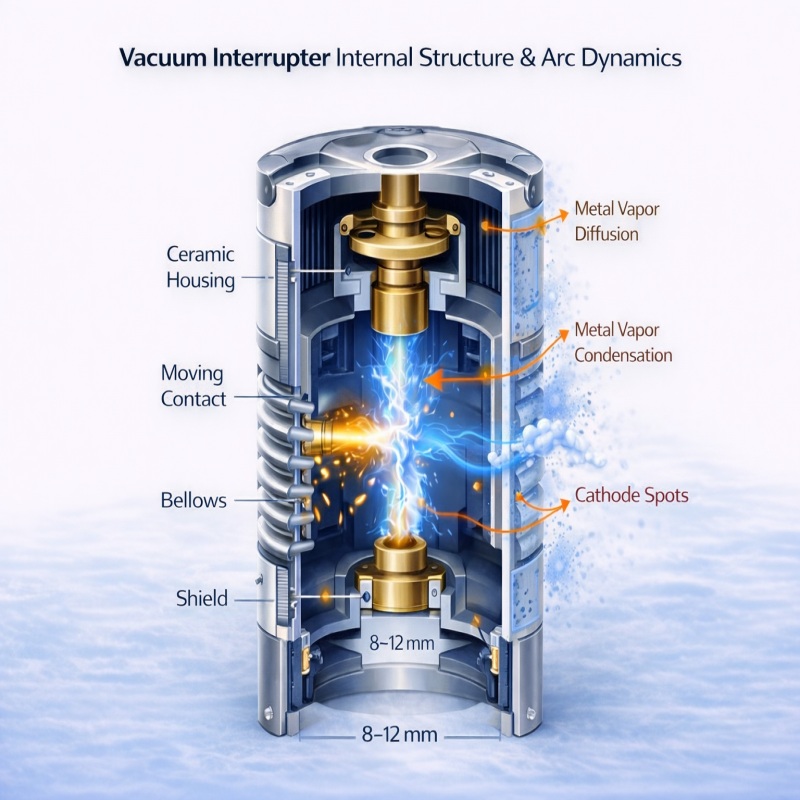
Its core feature is that the generation and extinction of all electric arcs occur within a sealed vacuum interrupting chamber. The internal pressure of this chamber is maintained at 10⁻⁴to 10⁻⁶Pa, and the molecular free path is much larger than the contact distance, preventing the arc from burning continuously.
Working principle of vacuum circuit breaker
How does an electric arc generate and extinguish in a vacuum?
When the VCB contacts separate, high current density creates cathode spots on the contact surface, causing localized metal evaporation and forming a metal vapor plasma that creates a conductive channel,the vacuum arc.
Unlike arcs in air or oil, vacuum arcs do not rely on external gas ionization; instead, the contact material itself provides the charge carriers.
At the instant the alternating current naturally crosses zero:
- Metal vapor rapidly condenses on the shield and contact surfaces;
- The dielectric strength of the vacuum gap recovers to its initial level within microseconds;
- If the rate of recovery voltage rise (RVR) is lower than the dielectric recovery strength, the arc is permanently extinguished.
Main Types of Vacuum Circuit Breakers
Classified by operating mechanism
| Type | Key Characteristics (American English) | Typical Applications |
| Spring-Operated Mechanism | Proven and highly reliable; can be operated with AC or DC control power and supports manual spring charging. | Conventional substations, industrial power distribution |
| Permanent Magnet Actuator (PMA) | No mechanical latching, fewer moving parts, and very long service life (often >100,000 operations). | Smart ring main units (RMUs), applications with frequent switching |
| Solenoid (Electromagnetic) Mechanism | Simple design, but high power consumption and larger size compared to modern alternatives. | Legacy systems and retrofit projects (being phased out) |

Key Technical Parameters
| Parameter | Typical Value | Standard Basis | Engineering Significance |
| Rated Voltage | 12 kV / 24 kV / 40.5 kV | IEC 62271-100 | It must be matched to the system’s highest operating voltage (Um). |
| Rated Current | 630 A – 4000 A | — | Determines conductor cross-section and temperature rise |
| Rated Short-circuit Breaking Current | 20 kA – 63 kA | — | The maximum short-circuit capacity of the system needs to be checked. |
| Mechanical life | ≥30,000 pieces(PMAType) | IEC 62271-1 | Impact on maintenance cycle and replacement cost |
| Contact material | Cu-C Ralloy(Copper Chromium) | — | High resistance to fusion welding, low cut-off value(<5 A) |
Typical Engineering Applications
| Application Scenarios | Configuration Requirements | Technological Advantages |
| Metal-enclosed Switchgear(MV Switchgear) | Handcart-type VCB + Microprocessor Protection | Rapid fault clearance(<60 ms),Supports uninterrupted maintenance |
| Wind Power/Solar Power Booster Station | Outdoor pillar-mounted VCB or compact RMU | Adaptable to frequent switching, with no risk of SF₆leakage. |
| Capacitor Bank Switching | Dedicated low cutoff VCB | Avoid reignition overvoltage and extend capacitor life. |
| Motor Feeder Protection | High breaking capacity VCB + comprehensive protection | Reliably cut off stall current(Up to 8–10 × In) |
Conclusion
Vacuum circuit breakers (VCBs) represent a successful paradigm for the evolution of medium-voltage switchgear technology towards high reliability, low maintenance, and environmental friendliness. For engineers and EPC teams, the key lies in accurately grasping its technological boundaries.
With the integration of permanent magnet mechanisms, intelligent monitoring, and digital twin technology, VCBs are upgrading from “passive protection devices” to “active sensing nodes,” becoming an indispensable intelligent terminal in new power systems.
FAQ
1.Why can’t vacuum circuit breakers be used in systems above 38 kV?
The power frequency withstand voltage limit of a single vacuum interrupter is approximately 80–100 kV. Higher voltages require multiple breaks connected in series, but this presents problems such as uneven voltage distribution, complex synchronization control, and soaring costs. In contrast, SF₆ circuit breakers offer greater technical and economic advantages at 72.5 kV and above.
2. What is “current-cutting overvoltage”? How can it be suppressed?
When the VCB interrupts a small inductor current, the arc may be forcibly extinguished (current cut-off) before the current naturally crosses zero, causing the energy stored in the inductor 12LI221LI2 to be converted into overvoltage.
Suppression measures:
- Select a low current-cutting contact material (such as Cu-Cr alloy, current-cutting value <3 A);
- Install an RC absorption device or a surge arrester (MOA) on the load side.
3. How can a vacuum interrupter be guaranteed to be leak-free for 30 years?
Through a fully sealed welding process and an ultra-clean assembly environment, the following are achieved:
- Materials undergo strict degassing treatment to prevent internal venting
- Bellows are made of oxygen-free copper or stainless steel, with a fatigue life >100,000 cycles
- Helium mass spectrometry leak testing is performed before shipment
4. Comparison of permanent magnet mechanisms and spring mechanisms
| Dimension | Spring Mechanism | Permanent Magnet Mechanism |
| Moving Parts | >50个 | <10个 |
| Mechanical Life | 10,000–20,000 pieces | >100,000 pieces |
| Operating power consumption | High (requires a high-power closing coil) | Low (pulse current required only) |
| Maintenance requirements | Regular lubrication is required. | Maintenance-free |
| Intelligent | Difficult to integrate | Natural support status monitoring |
5.How can we verify whether the vacuum level of a vacuum interrupter is up to standard?
Commonly used on-site methods:
- Power frequency withstand voltage test: Apply 42 kV/1 min; if breakdown occurs, the vacuum fails
- Vacuum degree tester: Directly read the air pressure value
- Observe contact erosion: Severe oxidation or welding indicates vacuum leakage
6.Can VCBs be used for capacitor bank switching?
Yes, but a dedicated model must be used:
- Extremely low current cutoff (<2 A) is required to prevent reignition overvoltage
- The contact design must suppress multiple reignitions
- It is recommended to use a series reactor to suppress inrush current
--- END ---
Let’s Get Started
Providing you with the most trusted energy solutions in an unpredictable world.
Contact UsRequest an Insurance Quote

Our Products
As a trusted manufacturer, we provide advanced equipment that supports the digital transformation and sustainability of the electrical grid.
Our carefully crafted product range meets the unique needs of different countries and clients.
More Products

