- Telephone: +86-139-8977-9778
- Email: jack@toonice.com
- English


LV vs MV Switchgear: 10 Differences You Need to Know
Dec 15,2025
Switchgear functions as the backbone of power distribution, protecting equipment and keeping the lights on. For anyone designing a facility or managing a grid, picking the right gear depends on understanding how Low Voltage (LV) and Medium Voltage (MV) systems actually operate. Below is a breakdown of the 10 ways these two systems stand apart.
Defining the Boundaries
Low Voltage (LV) Switchgear
LV gear operates at 1,000V or less. You find these units in houses, retail stores, and light industrial shops. They house simple breakers and fuses that stop power flow if a circuit gets overloaded.
Medium Voltage (MV) Switchgear
MV systems handle the heavy lifting, ranging from 1,000V to 36,000V. These are built for the high-power demands of hospitals, data centers, and utility substations. They use specialized tech to snuff out high-energy electrical arcs safely.
Technical Comparison at a Glance
| Feature | Low Voltage (LV) | Medium Voltage (MV) |
| Voltage Limit | Up to 1,000V | 1,000V to 36,000V |
| Common Users | Offices, Homes, Small Shops | Factories, Power Plants, Grids |
| Insulation | Air | Vacuum, SF6 Gas, or Oil |
| Control | Manual / Local | Remote / SCADA Integrated |
| Footprint | Small & Modular | Large & Heavy-Duty |
10 Major Differences
1. Voltage Thresholds
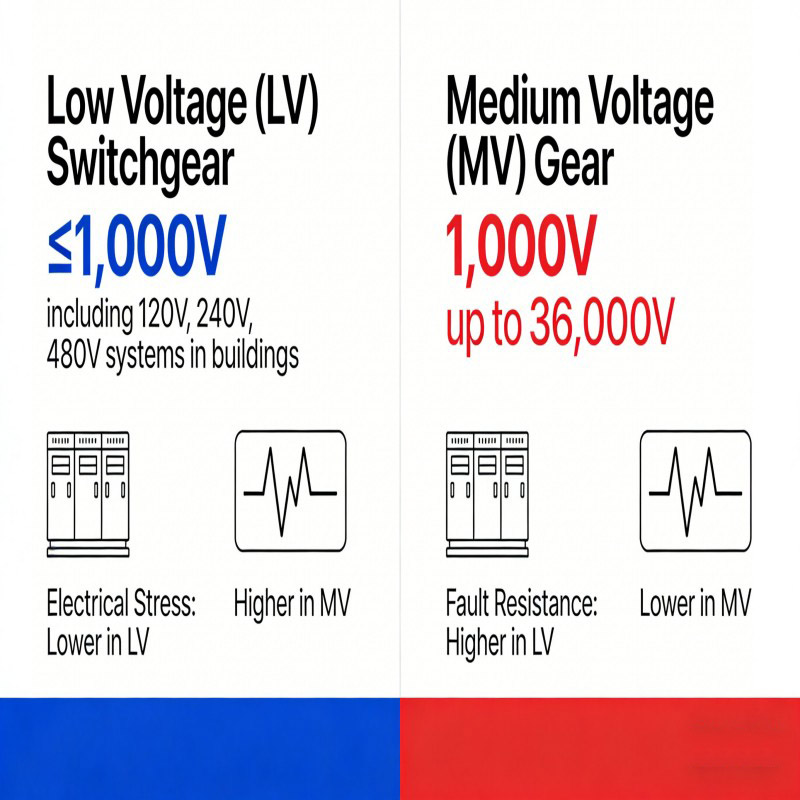
The primary divider between these two systems is the operating power level. Low Voltage (LV) switchgear is built for systems that stay at or below 1,000V. This covers the standard 120V, 240V, and 480V systems found in everyday buildings. Medium Voltage (MV) gear begins exactly where LV ends, spanning the range from 1,000V up to 36,000V. Because the energy levels in the MV range are significantly higher, the equipment must be built to withstand much greater electrical stress and potential faults without failing or causing damage to the surrounding facility.
2. Physical Footprint and Clearances
Space requirements differ vastly between the two. LV switchgear is often compact and modular, designed to fit into tight electrical closets or basements in commercial buildings. In contrast, MV switchgear is massive. It requires much larger clearances—the physical distance between live parts—to prevent electricity from jumping through the air (arcing). Because of this “arc clearance” requirement, MV systems often need dedicated rooms with high ceilings or outdoor “E-Houses” (Electrical Houses) that are specifically engineered to keep the high-voltage equipment separated from personnel and other infrastructure.
3. Insulation Media
In LV systems, ambient air is usually a sufficient insulator to keep electricity from jumping between conductors. However, as voltage increases into the MV range, air loses its effectiveness. To keep MV units at a manageable size, manufacturers use specialized insulation media like Vacuum, SF6 Gas (Sulfur Hexafluoride), or Oil. These substances have much higher dielectric strength than air, meaning they can extinguish electrical arcs in a much smaller space. This choice of media fundamentally changes how the switchgear is built, sealed, and maintained over its multi-decade lifespan.
4. Circuit Breaker Technology
The way these systems “break” a circuit during a fault is technically distinct. LV units typically use Air Circuit Breakers (ACB) or Molded Case Circuit Breakers (MCCB), which are relatively simple mechanical devices. MV units rely on Vacuum Circuit Breakers (VCB) or Gas-Insulated Switchgear (GIS). In an MV VCB, the electrical contacts part inside a vacuum bottle where no air exists to support an arc. This allows the system to interrupt massive amounts of energy almost instantly, preventing the catastrophic damage that a high-voltage short circuit would otherwise cause.
5. Deployment Settings
You will find LV switchgear at the “consumer end” of the power chain. It is the final stage of distribution before electricity reaches your lights, computers, and HVAC systems. MV switchgear sits “upstream.” It acts as the primary intake point for large-scale operations like hospitals, airports, and factories. These facilities pull high-voltage power directly from the utility grid to move electricity across long distances efficiently. The MV gear then feeds into transformers, which step the voltage down to the LV levels used by the actual equipment on-site.
6. Automation and SCADA Integration
LV gear is frequently operated manually; a technician might physically flip a switch or a breaker on the panel. Because MV systems involve life-threatening energy levels, they are almost always integrated into a SCADA (Supervisory Control and Data Acquisition) system. This allows operators to monitor loads, check system health, and open or close breakers from a remote control room miles away. Advanced automation in MV gear also enables “smart grid” features, such as automatic bus-transfer schemes that switch power sources instantly if one line fails.
7. Maintenance and Skill Levels
Maintaining these systems requires two different worlds of expertise. A standard licensed electrician can usually manage LV maintenance and basic repairs. However, MV gear demands specialized high-voltage technicians. Because of the risk of “induced voltage” and lethal discharge, working on MV gear involves rigorous safety protocols like “Lock-Out, Tag-Out” (LOTO) and the use of specialized grounding trucks. Technicians must also be trained in gas handling (for SF6 units) and vacuum integrity testing, skills that are not required for standard low-voltage work.
8. Arc-Flash Safety Measures
While all electrical gear carries an arc-flash risk, the potential “blast” from an MV fault is significantly more powerful. To manage this, MV switchgear features advanced Arc-Flash Mitigation. The cabinets are made of heavy-gauge reinforced steel with “arc-resistant” ratings. They include internal pressure-relief flaps or chimneys that vent explosive gases and fire upward and away from anyone standing in front of the unit. LV gear has safety features, but it rarely requires the complex “blast-chute” engineering found in high-energy MV installations.
9. Upfront and Long-Term Costs
The financial commitment for these systems is at opposite ends of the spectrum. LV switchgear is a commodity item; it is relatively affordable and has a straightforward supply chain. MV switchgear is a major capital investment. Beyond the high initial purchase price, the “Total Cost of Ownership” includes specialized relay testing, gas density monitoring, and periodic dielectric strength tests. You also have to factor in the cost of the specialized environment (the E-House or reinforced room) required to house the MV gear safely.
10. Industry Standards and Compliance
The two categories follow entirely different regulatory rulebooks. LV switchgear is typically governed by standards like IEC 61439 or UL 891, which focus on temperature rise and short-circuit withstand at low levels. MV gear must comply with much more rigorous codes, such as IEC 62271. These standards cover everything from how the gear handles “transient overvoltages” (like lightning strikes) to the environmental impact of insulating gases. Compliance for MV gear involves much more intensive factory witness testing before the equipment is even allowed on-site.
Which One Does Your Project Need?
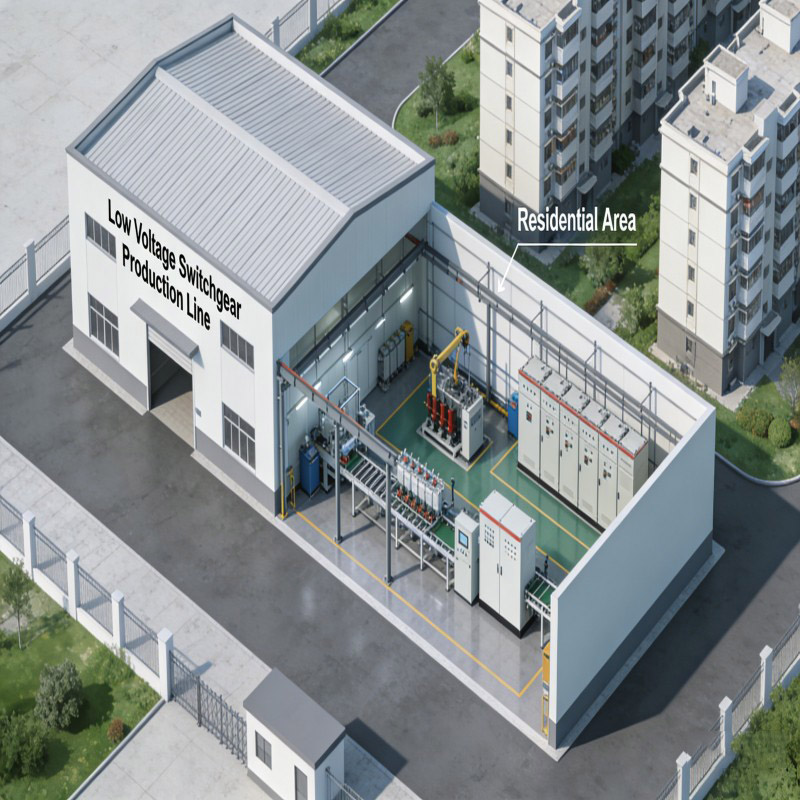
- Go with LV if: You are wiring a standard building, a small production line, or a residential complex where the utility has already stepped the voltage down for you.
- Go with MV if: You are building a large-scale facility that pulls power directly from the grid at high voltages or if you need to move power across a large campus without losing energy.
Ready to Secure Your Power Infrastructure?
Choosing between LV and MV switchgear is a high-stakes decision that impacts your facility’s safety, budget, and long-term scalability. Whether you are upgrading a commercial building or designing a high-capacity industrial plant, our engineering team can help you navigate the technical specifications and local compliance requirements.
Contact us today for a technical consultation or a detailed quote for your next switchgear project. Let’s build a power system that grows with your business.
--- END ---
Let’s Get Started
Providing you with the most trusted energy solutions in an unpredictable world.
Contact UsRequest an Insurance Quote

Our Products
As a trusted manufacturer, we provide advanced equipment that supports the digital transformation and sustainability of the electrical grid.
Our carefully crafted product range meets the unique needs of different countries and clients.
More Products

