- Phone / WhatsApp:+86 157 0677 9792
- sales@toonice.com
-
English
Comprehensive Guide to Secondary Power Lines and Distribution Products
Nov 14,2025
Power distribution is the backbone of modern life, yet few people understand how electricity moves from high-voltage grids to everyday use in homes and businesses.
The unsung hero of this process is the secondary power distribution system. This network of transformers, secondary power lines, and electrical components ensures that electricity is safely reduced to usable voltage levels.
We’ll take a closer look at what secondary power really means and explore how secondary electricity differs from primary power. Then, we’ll highlight the key power distribution products that keep secondary systems reliable and efficient.
What Is Secondary Power Distribution?
1. Definition and Scope
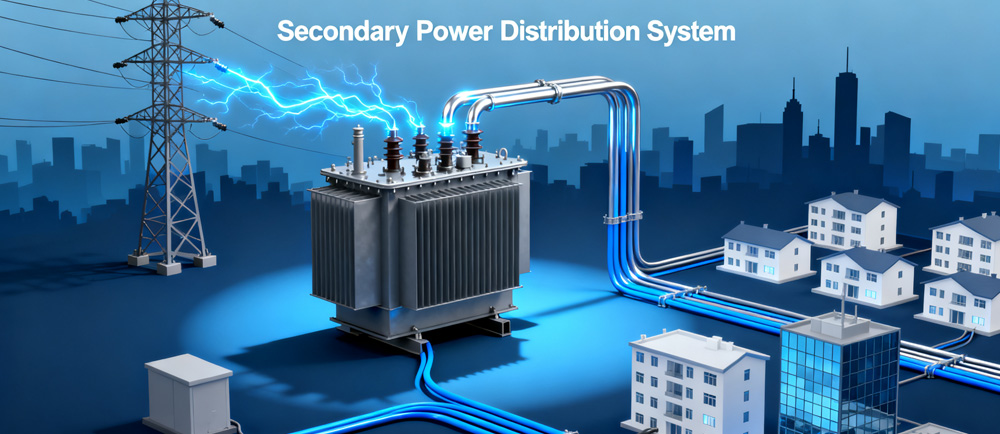
In an electric network, secondary power refers to the low-voltage electricity delivered to end users after the final step-down transformation. In other words, secondary distribution is the portion of the grid that carries power from distribution transformers typically mounted on poles or in substations to the customers’ service entrance or meter.
This is the last leg of electricity delivery, linking the medium-voltage network to individual utility meters. Secondary power is also commonly called the low-voltage distribution system.
2. Voltage Characteristics
Secondary distribution networks operate at the voltages used by everyday appliances. Most modern secondary systems run at mains voltage levels, typically around 100–120 V or 230–240 V AC at 50 or 60 Hz per phase.
These voltages are much lower than those on primary feeders, so the electricity remains safe and usable for consumers’ equipment. The distribution transformer performs the crucial step of converting medium voltage to this low voltage range.
For example, a transformer may step a 13 kV feeder down to 240/120 V for a residential neighborhood. Its output feeds into secondary lines that supply several homes or businesses nearby. Frequently, one transformer serves a cluster of customers through a secondary network, with each user connected via a service drop and meter.
Primary vs. Secondary Distribution
To better understand secondary power lines, it’s useful to contrast them with primary distribution lines (the medium-voltage feeders). Both are parts of the overall distribution grid, but they have distinct characteristics and roles. Below are key differences between primary and secondary distribution:
Voltage Level
Primary distribution lines carry electricity at medium voltages, typically from a few kV to around 35 kV. Secondary power lines carry low voltages, usually between 120 V and 480 V, suitable for end-user consumption. For instance, a common North American configuration is a 7.2 kV or 12.5 kV primary feeder and a 120/240 V secondary service to homes.
Location and Physical Layout
On a typical utility pole, primary lines (or “primaries”) are the higher wires mounted at the top, often bare or only lightly insulated conductors. Secondary lines (or “secondaries”) are attached lower on the pole, below the distribution transformer.
They are frequently insulated cables for safety since they are closer to the ground and people, and carry power from the transformer to buildings.
In many residential areas, secondary distribution lines can also be underground cables running beneath streets. This approach is especially common in newer or urban developments where aesthetics and reliability are priorities.
Coverage and Distance
A primary feeder typically runs several kilometers from a substation, distributing bulk power to an entire neighborhood or area. Along its route it energizes many transformers, each serving a local load pocket. Secondary power lines, by contrast, cover much shorter distances.
They often span only a few tens or hundreds of meters from the pole-mounted or pad-mounted transformer to the end users. Several customers are usually fed from one transformer via secondary lines branching out in a small radius.
Because secondary voltages are lower, these lines cannot economically carry power over long distances. Voltage drop and losses would be too high, so the span of secondary networks is kept limited.
Equipment and Protection
The primary distribution system needs robust switchgear to manage medium voltages and interrupt high fault currents. Equipment includes circuit breakers, reclosers, and load-break switches.
The secondary system uses simpler, lower-rated devices such as fuses and low-voltage breakers to protect against overloads. Underground systems often rely on ring main units (RMUs), while overhead networks use pole-mounted disconnect switches to isolate or reconfigure sections for maintenance.
Safety Considerations
Although secondary voltages (under 600 V) are much lower than primary voltages, they can still be dangerous. Utility workers and first responders are trained to treat secondary lines with caution, as contact can result in severe electric shock.
The lower voltage also means higher currents for a given power demand, so secondary conductors are thicker and shorter to handle the current without excessive voltage drop. The primary lines, while carrying less current, pose high-voltage hazards and are usually kept well clear of accidental contact.
Overhead vs. Underground Secondary Power Lines
Overhead Secondary Lines
Overhead secondary lines are common in rural and older suburban areas. They run along utility poles, carrying low-voltage power from transformers to nearby buildings through insulated cable bundles or open-wire mains.
These lines are inexpensive and easy to extend, but long runs can cause voltage drop and power loss. Utilities often place transformers closer to loads in remote areas to minimize these issues.
Underground Secondary Lines
Underground secondary lines are typical in urban or new residential developments. Transformers are pad-mounted or placed in vaults, and insulated cables are buried in conduit or directly underground.
This setup improves reliability and aesthetics but increases installation and maintenance costs. Despite higher expenses, utilities favor underground systems in high-density zones for long-term safety and reduced outages.
Design Considerations
Both overhead and underground configurations serve the same purpose: delivering energy from the transformer’s secondary terminals to end users.
In dense areas, a main secondary line may feed multiple customers, while in isolated locations, a single transformer may connect directly via a short service drop. Utilities balance cost, efficiency, and reliability when deciding the best layout for secondary lines.
Key Secondary Power Distribution Products
Ring Main Units (RMUs)
Ring Main Units are compact, metal-enclosed switchgear assemblies used in ring-type distribution networks. Each RMU integrates two incoming switches and one outgoing feeder circuit breaker or fuse that supplies a distribution transformer.
RMUs may use air, oil, or SF6 gas for insulation and typically operate at voltages such as 11, 24, or 36 kV. They ensure continuity of supply and safe network operation in medium-voltage systems.
Overhead Line Solutions
Overhead line products are key components in power transmission and distribution, particularly in rural or suburban areas where overhead infrastructure is most economical.
They consist of conductors supported by poles or towers, with insulators and switchgear like Air Break Disconnectors or Load Break Switches. These devices, usually air- or SF6-insulated, cover common voltage levels of 11, 24, and 36 kV, providing flexibility and reliability for high and medium-voltage networks.
Distribution Network Automation
Modern distribution networks increasingly use automation systems to improve efficiency and response time. Remote Terminal Units (RTUs) allow utilities to monitor and control RMUs or overhead switches directly from central control centers. This remote capability reduces downtime, enhances fault detection, and supports smart grid operations.
Low Voltage Distribution Equipment
Low-voltage distribution equipment manages the final stage of electricity delivery between utility transformers and meters. Examples include distribution panels, fused cutouts, sockets, and LV switchboards used in homes and offices. These products are designed for safety, easy maintenance, and compliance with industry standards, ensuring smooth and secure power delivery to end users.
Considerations for Engineers and Utility Buyers
- Reliability: Secondary networks are usually radial, so a single fault can stop service. Fuse coordination and fault indicators improve uptime.
- Load: Proper conductor and transformer sizing prevents voltage drops and overheating.
- Efficiency: Shorter runs and efficient transformers reduce losses.
- Safety: Equipment must meet standards and ensure insulation and clearances.
- Automation: Smart sensors and remote control detect and manage faults quickly.
- Quality: Durable materials lower maintenance costs and boost performance.
Conclusion
Secondary power distribution connects large-scale generation to everyday use, ensuring safe and reliable energy for communities and industries. From transformers and cables to switchgear and panels, every component contributes to stability and efficiency.
Ready to optimize your secondary power systems? Contact Toonice for expert advice, custom product recommendations, and tailored power distribution solutions.

--- END ---

MV & LV Equipment Manufacturer · Wenzhou, China
COMPANY
PRODUCTS
INDUSTRIES